
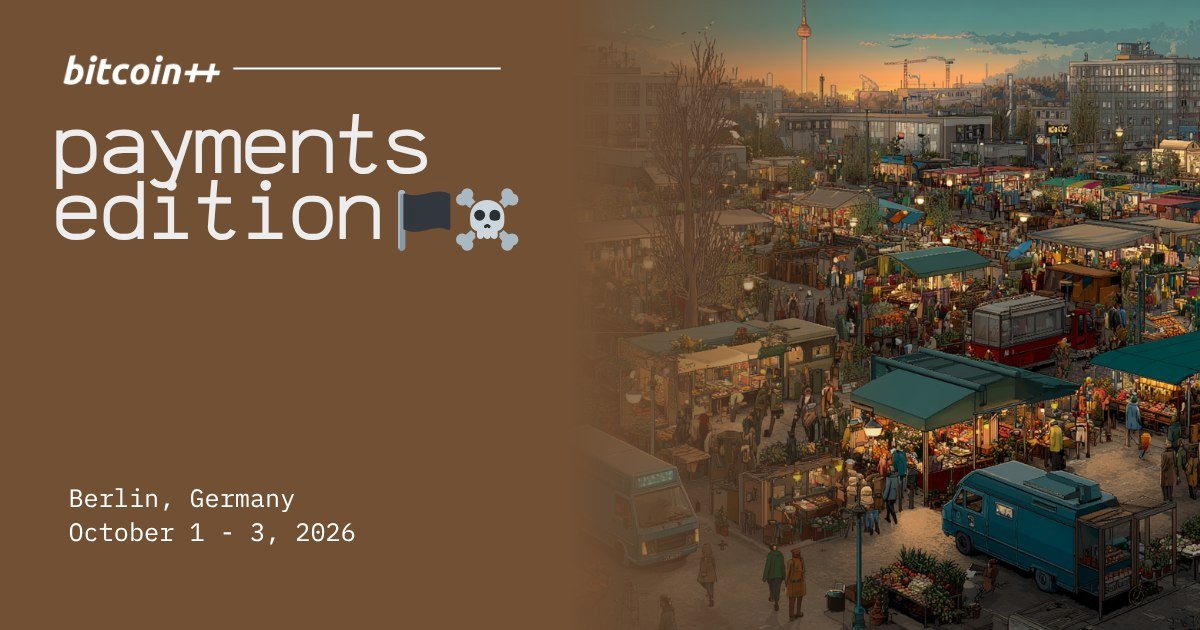
Bitcoin++ Berlin Payments Edition will bring builders together to tackle what comes next: making Bitcoin work as money.
After months of weakness, the market has snapped back sharply, with Bitcoin rallying above $70,000 this week, reaching levels not seen since June. On Friday, BTC pushed above the $75,000 mark, extending weekly gains to over 21% .
For traders, that is the story. For Bitcoin developers, there is another question: what happens when people actually want to use that increasingly valuable asset to pay for things?
That is precisely where bitcoin++ Berlin Payments Edition comes in.
Taking place October 1–3, 2026, at w3.hub in Berlin, the three-day event will bring together open-source developers, researchers, tinkerers and builders working on the infrastructure that allows value to move across Bitcoin. The program is explicitly focused on payments, with two stages, workshops, technical sessions and a 24-hour hackathon built around putting ideas into code.
Bitcoin is worth more. But is it easier to spend?
A decade ago, the dominant Bitcoin conversation was whether it could become a credible form of digital money. Today, a huge portion of the market treats it as a macro asset, a store of value and an institutional investment vehicle. Spot ETFs, corporate treasury strategies and increasingly sophisticated financial infrastructure have pushed Bitcoin deeper into traditional markets.
But none of that automatically solves the payments problem.
If Bitcoin is going to function as money, users need to be able to send it quickly, cheaply and reliably. Merchants need to be able to receive it without wrestling with block confirmations, volatile exchange rates or complicated infrastructure. And developers need tools that make the experience competitive with the payment systems people already use every day.
That is where the Lightning Network remains particularly important, moving transactions away from Bitcoin’s base layer and allowing users to make near-instant payments with much lower fees while ultimately relying on Bitcoin for settlement. The technology has spent years moving from an experimental protocol toward increasingly practical payment infrastructure, but there is still plenty of work to do around liquidity, routing, UX, reliability, interoperability and merchant integration.
The challenge is no longer simply proving that Bitcoin can move value, but making Bitcoin payments good enough that people actually want to use them.
Builders put at the center
That developer-first approach is what distinguishes bitcoin++ from a conventional Bitcoin conference.
The Payments Edition is being positioned as a hands-on hacking and building showcase rather than a three-day sequence of panels about the future of money. The event’s 24-hour hackathon will give participants a chance to build and demonstrate projects, with payments-related work receiving bonus consideration.
Among those appearing in Berlin is Allen Farrington, who will discuss The Fiat Payment Stack Returns (Part 2). Jesse Shrader, co-founder and CEO of AMBOSS Technologies, is set to explore Bitcoin’s FX Layer. Other contributors include developers and researchers working on Lightning, Cashu, Fedimint, Bitcoin POS systems, L402 and other parts of the Bitcoin payments stack.


That breadth is important because Bitcoin payments involve multiple challenges. There is the protocol itself. There is liquidity. There is routing. There are wallets and merchant interfaces. There are exchange-rate and foreign-exchange considerations. There are privacy questions. There are stable-value and e-cash systems. There are increasingly sophisticated ways of integrating Bitcoin payments into existing businesses.
Solving the payments problem means working on all of them.
Moreover, a rising Bitcoin price makes the payments problem more interesting. The more valuable the asset becomes, the harder it can be psychologically to spend it.
If someone expects Bitcoin to appreciate significantly, spending 0.01 BTC today can feel very different from spending the same amount when Bitcoin is trading at a fraction of its current price.
But that is precisely why the infrastructure matters. A monetary network does not become useful merely because its underlying asset appreciates, it becomes useful when people can receive, hold, exchange and spend value with minimal friction. And Bitcoin’s price volatility makes that challenge more interesting, not less.
Bitcoin++ Berlin – Payments Edition
When: October 1–3, 2026
Where: w3.hub, Berlin
Focus: Bitcoin payments, open-source development, Lightning and related payment infrastructure
Format: Talks, workshops, hacking and a 24-hour hackathon
Website: https://btcpp.dev/berlin26