

Bitcoin’s sharpest rally in months has erased billions in bearish bets. The next test is whether real demand can keep prices moving once the forced buying fades.
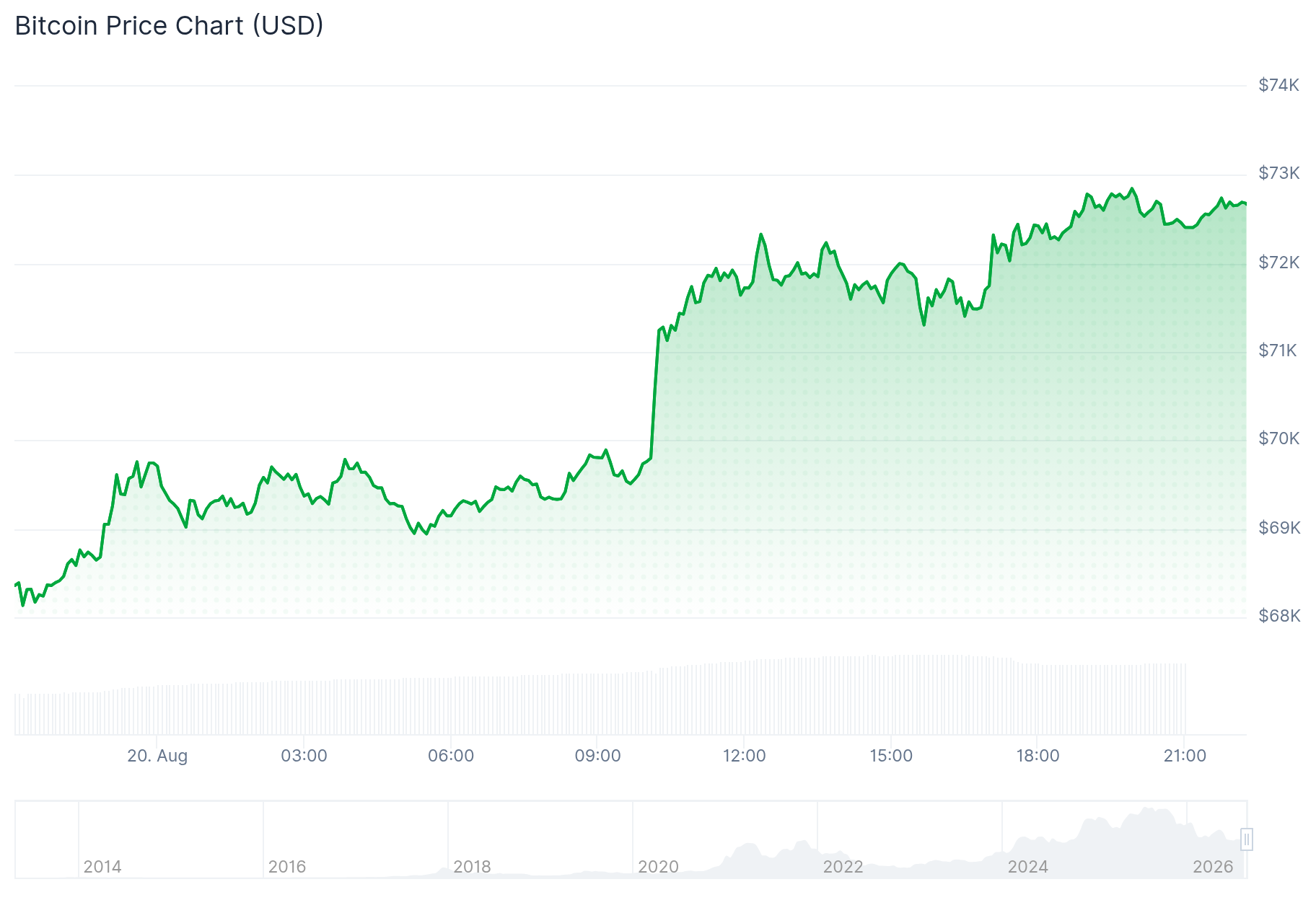
Bitcoin surged above $72,000 on Thursday, extending a rally that has lifted the cryptocurrency roughly 14% since Monday and taken it to its highest level since early June.
The move accelerated after a surprise shift in U.S. Treasury policy sent long-term bond yields lower, while President Donald Trump renewed his push for Congress to pass the Clarity Act, a bill that would establish a federal framework for digital assets.
But the rally has also been fueled by a wave of forced buying as traders betting against Bitcoin have been squeezed out of their positions.
Short liquidations topped $3 billion across Wednesday and Thursday, turning what began as a macro-driven rebound into a powerful short squeeze. Bitcoin touched $72,844 on Thursday, according to data from CoinGecko, before giving back some of the gains.
The question now is whether the move can survive without the forced buying that helped fuel it.
What Started the Move
The first catalyst came from Washington.
On Wednesday, the U.S. Treasury announced that it would at least double the size of its long-term bond buyback operations, increasing the amount repurchased in each operation from $2 billion to at least $4 billion. The program, targeting Treasury securities with maturities of 10 to 30 years, is scheduled to run from September 9 through November 4.
The announcement came as long-term Treasury yields had climbed to multi-year highs, with the 30-year yield reaching roughly 5.3%. Yields subsequently fell sharply, while the dollar weakened.
For traders, the significance was less about the size of the buybacks, which remain small relative to the roughly $31 trillion Treasury market, and more about what the move signaled. Markets interpreted the intervention as an attempt to ease stress in the long end of the bond market and improve liquidity.
Some traders quickly described the move as “QE Lite.” That comparison should not be taken literally though as the Treasury is buying back its own debt, not creating money in the manner of a Federal Reserve quantitative-easing program.
The second catalyst came from the White House, as President Trump urged Congress to advance the Clarity Act during a meeting with executives from Coinbase, Robinhood, Kraken, Ripple, Gemini, Nasdaq and other companies. The legislation aims to establish clearer rules governing digital assets and the respective jurisdictions of the Securities and Exchange Commission (SEC) and Commodity Futures Trading Commission (CFTC).
It’s time to make America the crypto capital of the world.@POTUS and the current administration have done an excellent job of moving us towards this. Now we need to get Clarity done. pic.twitter.com/3S0nJH6YxH
— Brian Armstrong (@brian_armstrong) August 20, 2026
The bill is currently stalled in the Senate and a procedural vote on September 15 is now the next major test for the legislation, although its prospects remain uncertain.
Neither development, on its own, explains the speed of Bitcoin’s move. Together, however, they gave traders a reason to reassess bearish positions just as a heavily shorted market was beginning to move higher.
Billions in Bearish Bets Unwind
That is where the short squeeze took over.
A trader shorting Bitcoin borrows or synthetically sells the asset in the expectation that its price will fall. If Bitcoin instead rises sharply, losses on the position increase. Once the trader’s collateral is no longer sufficient, the exchange will automatically close the position by buying Bitcoin.
That forced buying pushes the price higher, potentially triggering additional liquidations and creating a feedback loop.
On Wednesday, more than $1 billion in Bitcoin short positions were liquidated in roughly an hour as BTC broke above $69,000. It was the second-largest single-day short-liquidation event on record, behind the October 2025 crash. The liquidation wave continued into Thursday. CoinGlass data puts total crypto short liquidations across the two-day period above $3 billion.
| Glimpse is a Bitcoin-native prediction market that allows participants to trade on future Bitcoin price outcomes. By combining market incentives with probabilistic forecasting, Glimpse helps users test their market views, build forecasting track records and contribute to a live forecast of where Bitcoin is headed next. |
Sellers Are Returning, Too
There is already evidence that some Bitcoin holders are using the rally to exit positions.
Short-term holders—coins that have remained relatively recently active on the blockchain—sent roughly 43,300 BTC to exchanges, according to CryptoQuant data. Moving Bitcoin to an exchange itself does not prove that the owner sold it, but a large increase in exchange-bound supply can indicate that holders are preparing to realize profits or reduce exposure.
The average cost basis for this group has been estimated around $68,700. Bitcoin’s move decisively above that level therefore puts many recent buyers back into profit—and potentially gives them an incentive to sell.
That creates an important battle for the next leg of the rally: new demand has to absorb supply from investors who have been waiting months for a chance to get out.
ETF Buyers Are Back
The institutional picture is more encouraging.
U.S. spot Bitcoin ETFs recorded $517.2 million in net inflows on Wednesday, the largest single-day inflow since May 4. BlackRock’s IBIT accounted for the largest share, with roughly $285 million entering the fund.
Still, one strong day is not enough to establish a trend.
ETF flows had been volatile through the summer, and analysts cited by The Block pointed to the Treasury intervention as one explanation for the sudden improvement. The more important question is whether inflows persist after the initial market shock fades.
The answer could depend heavily on macroeconomic data. Markets are now looking toward next week’s U.S. inflation data and further comments from Treasury Secretary Scott Bessent about whether the expanded buyback program represents a temporary intervention or something that could continue for longer.
Can Bitcoin Hold Above $70,000?
This is where the rally gets harder.
Short covering can accelerate a move, but it cannot sustain one indefinitely. Once the majority of trapped shorts have been forced out, the market needs fresh buyers willing to pay increasingly higher prices.
Bitcoin has now reclaimed several widely watched moving averages and moved back above the $70,000 area. It also broke above the 200-day moving average, a level that had capped the market during much of the recent downturn. Market analysts have consequently turned more constructive on the short-term technical picture.
Perhaps the most discussed data point Thursday came from CryptoQuant founder Ki Young Ju, who noted that Bitcoin demand has turned positive in both spot and perpetual futures markets for the first time since the October 2025 all-time high.
“The scale remains modest, but if this holds for another month, it would be reasonable to conclude that the bear market is over and a new bull cycle has begun,” he wrote on X.
For the first time since the October 2025 ATH, Bitcoin demand has turned positive in both spot and perpetual futures.
The scale remains modest, but if this holds for another month, it would be reasonable to conclude that the bear market is over and a new bull cycle has begun. pic.twitter.com/e8TAqeLySd
— Ki Young Ju (@ki_young_ju) August 20, 2026
Nansen senior research analyst Nicolai Søndergaard argued that short covering accelerated the breakout but did not create it on its own. He pointed to improving spot and ETF demand as additional support, while warning that rising leveraged long exposure could make the market vulnerable to another sharp reversal.
The key levels are clear: holding above $70,000 would strengthen the case that the breakout is becoming established, while a retreat back toward the high-$60,000s would test whether the move was driven primarily by forced positioning.
If Bitcoin can consolidate above the breakout zone while spot and ETF demand remain positive, the market will have stronger evidence that a genuine change in trend is developing. If price quickly falls back below that level as ETF flows weaken, this week’s move will look much more like a leverage-driven relief rally.
🔔 Follow BitcoinOnly Events on Twitter (X), LinkedIn, Telegram, and Substack to be updated on the latest news and insights.