
Bitcoin Monthly Dispatch follows Bitcoin’s story in motion: tracking the markets, corporate moves, regulatory environment, mining progress, protocol upgrades, Lightning Network growth, and the new tools and products driving adoption.
Bitcoin Price Action
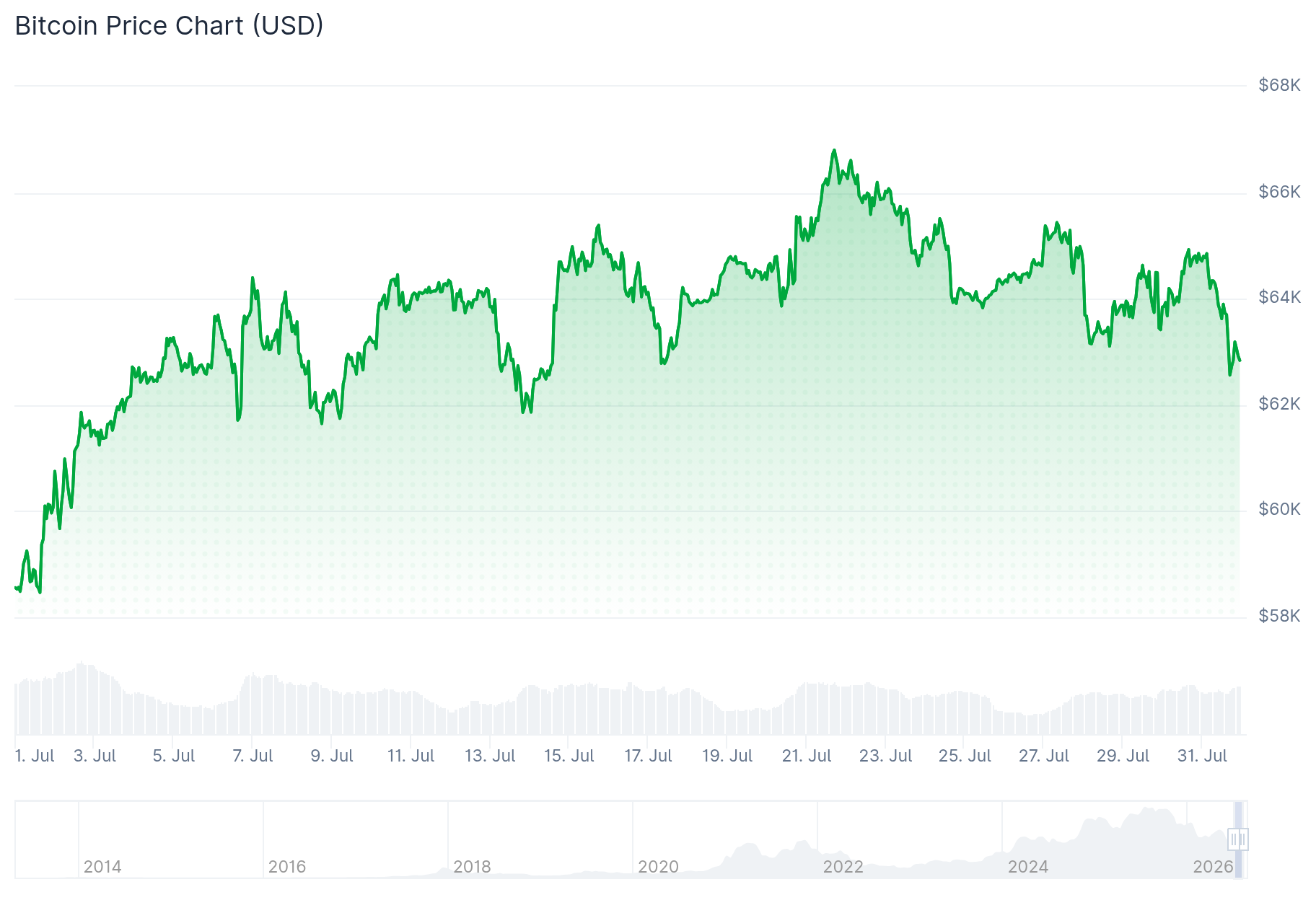
Bitcoin spent July doing what it did for most of the first half of 2026—trading below its own moving averages while institutions decided whether to keep de-risking or start buying back in. The month opened with BTC still working off a 21-month low under $59,000, the tail end of a brutal June that had closed with the first weekly finish below the 200-week moving average since 2023.
From there, price chopped inside a well-defined band: roughly $58,000–$63,000 in the first week, a recovery toward $64,000–$66,000 by mid-month, a wobble back below $65,000 on July 24 tied to renewed US-Iran tension, and a close near $62,800 on July 31—a monthly gain that several outlets pegged at around 7%, Bitcoin’s best single month since the current recovery attempt began.
The main driver was ETF flow rather than a broad shift in sentiment. Bitcoin entered July after U.S. spot ETFs suffered their worst month since launch, with roughly $4.5 billion in net outflows in June. The funds had also endured an unprecedented eight-week stretch of weekly outflows, with more than $8 billion withdrawn from mid-May into early July.
The flow picture began to turn in July. Spot ETFs took in $221.7 million on July 2, followed by a broader stabilization that produced three consecutive weeks of net inflows. The weekly outflow streak was formally broken with $197.4 million of inflows in the week ended July 10. The recovery remained fragile, however. On July 23 and 24, the funds suffered a combined $465 million in outflows, with BlackRock’s IBIT accounting for nearly $415 million of the withdrawals.
By the end of July, U.S. spot Bitcoin ETFs had recorded only about $172 million in net inflows for the month, making July the weakest positive month since the products launched in January 2024. That modest net figure masked considerably larger swings beneath the surface, including nearly $1 billion of inflows during the strongest mid-month stretch before the late-month reversal. Citi research estimated that ETF flows accounted for roughly 45% of weekly Bitcoin price movement, underscoring how the creation-and-redemption cycle had become a meaningful mechanical force in the spot market.
In that sense, July’s price action was increasingly a story of liquidity and macro positioning: Fed expectations and broader risk appetite were transmitted into Bitcoin through ETF flows, often with more immediate impact than crypto-specific on-chain developments.
| Glimpse is a Bitcoin-native prediction market that allows participants to trade on future Bitcoin price outcomes. By combining market incentives with probabilistic forecasting, Glimpse helps users test their market views, build forecasting track records and contribute to a live forecast of where Bitcoin is headed next. |
Coldcard’s RNG failure
Late July delivered one of the most serious self-custody incidents in recent memory. A vulnerability affecting certain Coinkite Coldcard Mk3 devices allowed some wallets to generate seeds using a weak software random-number generator rather than the hardware entropy source intended to protect them. The issue was eventually traced to a build-configuration error dating back to 2021, but at the time of this writing the full scope of the failure, including how many wallets were affected and how much Bitcoin had been stolen, was still being investigated.
The first known attacks began on July 30, with hundreds of wallets reportedly drained in a coordinated sweep. Blockchain researchers initially identified roughly 594 BTC moving from affected addresses into a consolidation address, putting the value of the apparent theft at tens of millions of dollars. Additional transactions followed, suggesting the incident was substantially larger than the first wave indicated.
The vulnerability is particularly serious because it strikes at the point where a wallet’s security model begins: seed generation. According to the technical analysis emerging around the incident, affected Mk3 devices could produce seeds with dramatically reduced entropy, potentially bringing effective key strength down to roughly 40 bits rather than the 128 bits expected from a properly generated wallet seed. That does not constitute a break of Bitcoin’s cryptography; it means an attacker who can identify a vulnerable seed can potentially search the vastly smaller keyspace without ever gaining physical access to the device.
BIP-110 goes to war with the network
This was the defining story of the month and by the end of July it was far from over.
BIP-110, the “Reduced Data Temporary Softfork,” proposed imposing a consensus-level limit on OP_RETURN and other data-carrying transaction fields, targeting what its supporters see as the abuse of Bitcoin blockspace for Ordinals-style inscriptions and other non-monetary data. The proposal was released as a Bitcoin Knots fork rather than through Bitcoin Core, and set a 55% miner-signaling threshold—dramatically below the traditional 95% threshold used for major Bitcoin soft forks.
It still struggled to gain meaningful miner support. By the end of July, signaling had never come close to the 55% target, remaining below 3% for most of the month. OCEAN emerged as the most visible mining pool signaling for BIP-110, while Foundry USA took the unusual step of allowing its hashrate clients to decide whether to support the proposal rather than making the decision internally.
The political fight was just as significant as the technical one. Michael Saylor, Adam Back and many other prominent figures publicly came out against BIP-110, warning that changing Bitcoin’s consensus rules without broad economic agreement could set a dangerous precedent. Meanwhile, reachable Knots-based nodes climbed as high as roughly 22% of the network—enough to demonstrate meaningful support for the alternative implementation, but nowhere near enough to establish consensus.
Many Bitcoiners I respect support BIP 110. I understand and share their desire to protect Bitcoin, but believe the proposed cure is more dangerous than the condition. Here are 110 reasons why Bitcoin needs guardians of neutrality. https://t.co/hOAqfAgC58
— Michael Saylor (@saylor) July 19, 2026
By August 1, the numbers suggested that BIP-110 had failed to build the miner support its activation mechanism required. But declaring the battle over would be premature. The proposal had turned a long-running argument over Bitcoin blockspace into an unusually explicit dispute over who gets to decide what Bitcoin’s consensus rules should be—and that debate was only getting started.
Bitcoin’s Agent Economy Is Taking Shape
For years, the question was whether Bitcoin would ever be useful beyond holding. Two separate teams now answered it with software that lets machines earn, communicate, and spend without permission.
On July 21, Jack Dorsey’s payments company Block launched Buzz, an open-source team collaboration platform built on the Nostr protocol that treats AI agents as full members of a workspace, not bolt-on features. The same day, Lightning Labs announced Wavelength, an alpha toolkit that lets any developer—or any agent—add self-custodial Bitcoin payments to an application with a handful of API calls.
The announcements in question dropped from two different corners of the Bitcoin ecosystem, but they point in the same direction: toward a world where AI agents are not just tools sitting on top of software, but active participants in it—communicating, transacting, and working alongside humans on open, sovereign infrastructure.
Neither launch is finished, but they both matter: Buzz gives agents a place to work, whereas Wavelength gives them money to work with.
Mining difficulty retreats as hashrate pulls back from 2025 highs
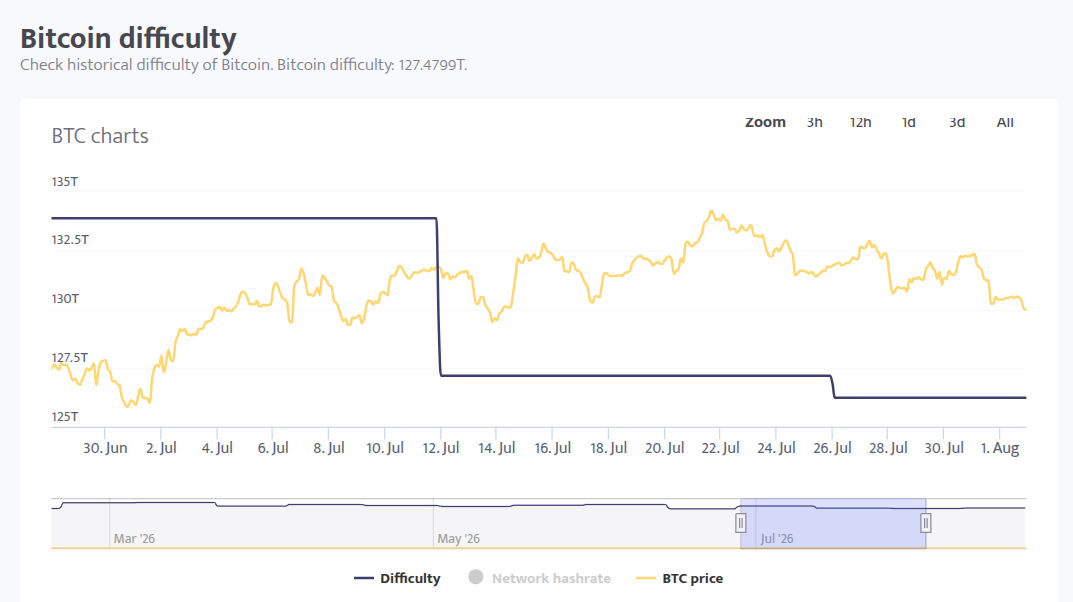
Bitcoin’s mining economics have been deteriorating for months, and by July the effect was becoming increasingly visible in the network’s difficulty data. Difficulty entered the year at elevated levels before peaking at 146.47 trillion on January 8. By the end of July, it had fallen to 126.23 trillion—a decline of roughly 14% from the 2026 high and about 19% from the all-time record of 155.97 trillion set in November 2025.
July itself brought two consecutive downward adjustments. Difficulty fell 5% to 127.17 trillion on July 11, followed by another 0.74% decline to 126.23 trillion on July 25, for a combined monthly drop of 5.71%. The July 11 adjustment was driven by a sharp decline in observed hashrate: the seven-day average stood at roughly 908 EH/s, down from more than 1.15 ZH/s at the October 2025 peak.
 Source: minerstat.com
The significance goes beyond a couple of negative difficulty adjustments. According to Hashrate Index, Bitcoin’s network difficulty had fallen year over year for only the second time in the blockchain’s history. The previous instance came in 2021 after China’s mining ban forced a large share of the network offline. The current contraction is different: there is no single policy shock driving it. Instead, weaker mining economics, the shutdown of less-efficient hardware, power curtailments and the migration of some infrastructure toward AI and high-performance computing are all contributing to the pressure on hashrate.
For miners that remain online, lower difficulty provides some relief by increasing the amount of BTC earned per unit of active hashrate. But that relief does not erase the underlying squeeze. Hashprice—the expected revenue generated by a unit of mining power—remained well below its October 2025 peak, leaving older and higher-cost fleets particularly exposed. July therefore looks less like a temporary anomaly than another stage in the ongoing repricing of Bitcoin’s mining industry.
The network itself is functioning as designed: when marginal hashrate leaves, difficulty adjusts downward and restores the economic incentive for the most efficient operators. The more important question heading into the second half of the year is how much additional capacity needs to come offline before mining economics stabilize.