
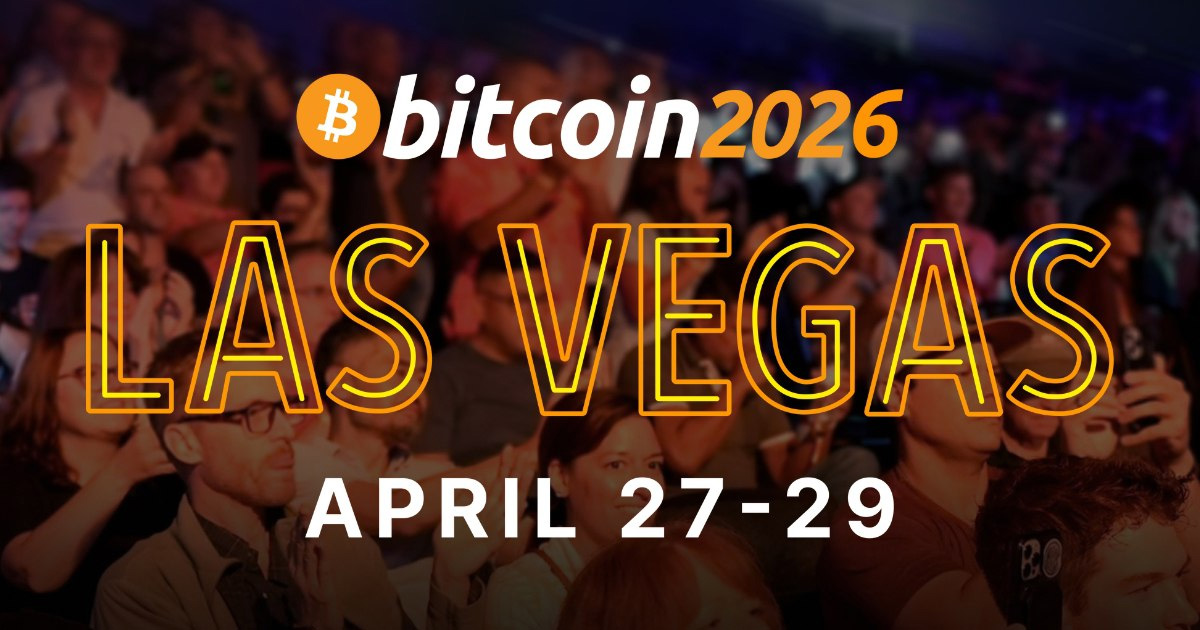
Bitcoin 2026 Las Vegas conference brings together regulators, legislators, and industry leaders as U.S. digital asset framework takes shape.
Bitcoin 2026 has released its first agenda ahead of the April 27–29 conference at The Venetian in Las Vegas, revealing a lineup that reflects the industry’s shift from pure technology focus to policy engagement and institutional adoption.
The conference marks a notable moment in Bitcoin’s regulatory maturity. SEC Chairman Paul Atkins and CFTC Chairman Mike Selig will both appear at the event, one of the first times both regulatory heads have attended a Bitcoin conference together. The timing is significant: major digital asset legislation is currently moving through Congress, and both agencies are navigating how existing securities and commodities frameworks apply to digital assets.
Atkins, who took over the SEC in early 2025, has signaled a more measured approach to crypto regulation than his predecessor. His appearance alongside Selig suggests coordination between the two agencies at a time when jurisdictional boundaries between securities and commodities remain contested.
BITCOIN 2026 AGENDA JUST DROPPED‼️
1ST ROUND – MORE TO COME 👀 pic.twitter.com/5mg70NXs3s
— The Bitcoin Conference (@TheBitcoinConf) March 27, 2026
Strategic Reserve Takes Center Stage
Senator Cynthia Lummis returns to the conference as the architect of the BITCOIN Act, which proposes establishing a U.S. strategic Bitcoin reserve of up to 1 million BTC. The Wyoming Republican first proposed the bill in 2024, reintroducing it last year, with the the legislation gaining traction as fiscal pressures mount and concerns about the dollar’s long-term stability grow among some policymakers.
The strategic reserve proposal represents a fundamental shift in how government could interact with Bitcoin. Rather than simply regulating it as an asset class, the bill would position Bitcoin as part of national treasury strategy. Whether the proposal gains sufficient support remains uncertain, but its presence in legislative debate reflects Bitcoin’s evolution from fringe technology to policy consideration.
Keynote Speakers Bridge Old and New
The keynote lineup includes figures who represent different phases of Bitcoin’s development. Arthur Hayes, co-founder of BitMEX and now CIO of Maelstrom, opens Monday with a keynote at 10:05 am. Hayes has been vocal about macroeconomic trends driving Bitcoin adoption, particularly monetary expansion by central banks.
Michael Saylor, founder and executive chairman of Strategy (formerly MicroStrategy), delivers Tuesday’s main keynote at 2:40 pm. Strategy currently holds over 700,000 BTC on its balance sheet, making it the world’s largest corporate Bitcoin holders. Saylor’s company has pioneered the corporate treasury Bitcoin strategy, and his appearance will likely address how institutions are approaching Bitcoin as a reserve asset.
Jack Mallers closes the conference Wednesday with a keynote at 3:50 pm. As founder of Strike and Twenty One, Mallers has focused on Bitcoin payments infrastructure and Lightning Network development. His companies represent efforts to make Bitcoin functional for everyday transactions, not just as a store of value.
Self-Custody Framed as Civil Liberty
Monday morning’s opening panel, “The Right to Self-Custody Shall Not Be Infringed,” brings together hardware makers, financial services providers, and policymakers to discuss self-custody as a civil liberties issue. The panel features Congressman Nick Begich, an original Mt. Gox account holder and early Bitcoin adopter now serving in the House.
As governments worldwide grapple with regulating digital assets, questions about whether individuals can legally hold their own keys without intermediaries have become contested. Some jurisdictions have proposed or implemented requirements that could limit self-custody, making this a live policy debate rather than abstract principle.
Joe Kelly from Unchained, which provides multi-signature custody services, and Zach Herbert from Foundation Devices, a hardware wallet maker, join the panel alongside Grant McCarty from the Bitcoin Policy Institute. The combination suggests the discussion will cover both the technical tools that enable self-custody and the policy frameworks that could protect or restrict it.
Mining Panel Addresses Open-Source Movement
Monday afternoon features “Open-Sourcing the Bitcoin Mining Ecosystem” at 12:30 pm on the Energy Stage. The panel examines efforts to open-source mining hardware and software, making the mining stack more transparent and accessible.
Bitcoin mining has become increasingly industrialized, with large operations dominating hashrate. The open-source hardware movement, represented by projects like the 256 Foundation’s Libre Control Board and Bitaxe, aims to lower barriers to entry and increase decentralization by making mining equipment designs publicly available.
The panel includes developers working on open firmware and control boards. Their work matters because mining centralization poses potential network risks. If mining becomes dominated by a small number of entities using proprietary systems, it could create chokepoints for censorship or control.
THE OPEN SOURCE STAGE AT BITCOIN 2026 IS ABSOLUTELY STACKED 🟠✊
Hear from exceptional speakers like @ODELLXYZ, @BTCsessions, @brian_trollz, @stephanlivera, @r0ckstardev, and more!
Full lineup 👉 https://t.co/TaQhULOjN1 pic.twitter.com/RMNTRqcKpv
— The Bitcoin Conference (@TheBitcoinConf) March 28, 2026
Lightning Network Economics Explored
Tuesday’s “Channeling Interest: How Companies Are Monetizing The Lightning Network” panel at 10:00 am addresses an emerging business model: earning returns by providing Lightning Network liquidity.
The Lightning Network enables fast, low-cost Bitcoin payments by moving transactions off the main chain. But the network requires participants to lock up Bitcoin in payment channels. Companies are now exploring how to generate revenue from this liquidity provision through routing fees and channel management.
Jesse Shrader from Amboss Technologies, which provides Lightning Network analytics and liquidity marketplace services, joins the panel along Shone Anstey, the CEO and Co-Founder of LQWD Technologies. The discussion represents Bitcoin’s evolution from speculative asset to infrastructure that supports business models.
AI Agents Meet Bitcoin
Tuesday morning’s “Why AI Agents Want Bitcoin” panel at 10:45 am on the Open Source Stage explores autonomous agents using Bitcoin for payments and settlement.
The premise: as AI systems become more autonomous, they need a payment system that works programmatically without requiring human intermediaries. Bitcoin’s design as permissionless, programmable money makes it a natural fit for machine-to-machine transactions.
This represents an emerging use case that extends beyond human users. If autonomous systems begin transacting at scale, Bitcoin’s properties—particularly its ability to settle value without trusted third parties—could become increasingly relevant.
Regulatory Battle Lines Examined
Tuesday’s “Then They Fight You” panel at 11:30 am takes its title from the Gandhi quote about movements facing opposition. The panel includes Caitlin Long from Custodia Bank, which spent years battling to obtain a banking charter that would allow it to custody digital assets.
Custodia’s experience is a perfect illustration of regulatory friction. Despite meeting statutory requirements, the bank faced resistance from the Federal Reserve and ultimately operated without the master account access that would allow it to interface directly with the U.S. banking system. Long has been vocal about what she sees as regulatory bias against Bitcoin-native institutions.
Chris Lane from Silvergate Bank, which shut down in 2023 amid regulatory pressure during the banking crisis, also joins the panel. Silvergate’s closure eliminated a key on-ramp for institutional Bitcoin access and raised questions about whether regulatory action contributed to its demise.
The panel title and participants suggest a discussion about institutional resistance to Bitcoin adoption and what legal strategies exist to challenge it.
Education and Culture Panels
The conference includes sessions on Bitcoin’s cultural evolution and education initiatives. “More than Just Plebs: The Evolution of Bitcoin Culture & Community” on Monday examines how Bitcoin’s culture has shifted from cypherpunk origins to a broader movement including entrepreneurs, educators, and institutions.
The education panel “Majoring in Bitcoin: Designing a Curriculum for Higher Education” on Monday features Korok Ray from Texas A&M, who teaches Bitcoin-only courses at a major U.S. research university. His appearance signals Bitcoin’s gradual integration into academic institutions.
BTC Sessions marks 10 years of Bitcoin education with a short presentation Tuesday morning. The Canadian educator has created thousands of tutorials helping users understand Bitcoin wallets, nodes, and privacy tools.
Conference Scope
The full agenda includes dozens of additional panels covering mining optimization, healthcare applications, sovereign commerce platforms, and regulatory strategy at the state level. The breadth suggests Bitcoin’s expanding scope beyond financial speculation into energy infrastructure, legislative strategy, and practical applications.
Additional speaker announcements are expected in coming weeks. The event takes place April 27–29 at The Venetian in Las Vegas.