
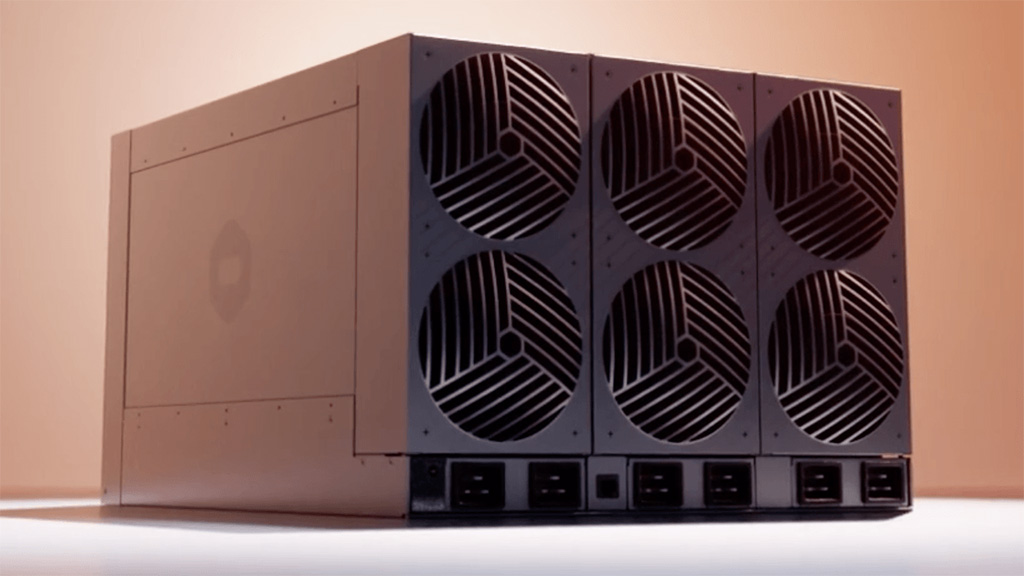
Last week, Block’s mining-focused arm, Proto Global, unveiled the Proto Rig, a first-of-its-kind modular Bitcoin mining system designed to treat mining hardware not as disposable equipment but as sustainable infrastructure. With drag-and-drop hashboard upgrades, tool‑free repairs, and a decade‑long lifecycle, the Proto Rig promises to redefine the economics of the industry.
Here are five key facts about Block’s latest offering.
1. Built to Last a Decade
Traditional Bitcoin mining rigs typically run for three to five years before obsolescence or wear makes them uneconomical. Block’s Proto Rig flips that script: it’s designed with a ten-year lifecycle.
Instead of discarding entire machines, operators can swap in new hashboards and components as technology evolves. Block estimates this modularity could save miners 15–20% on each upgrade cycle, while keeping rigs running in production longer.
greatest bitcoin miner of all time: https://t.co/sZUp23k3VT
— jack (@jack) August 14, 2025
2. Infrastructure, Not Just Hashrate
Boasting a 14.1 J/TH efficiency rating and 819 TH/s hashrate, the Proto Rig competes with top-tier mining equipment. Its design maximizes power density, delivering 1.5 times the power per foot of rack space compared to conventional models, making it suitable for both new and legacy mining facilities. This efficiency is critical as miners face rising operational costs post-Bitcoin halving, where profitability hinges on optimizing energy use.
Yes, the Proto Rig delivers serious performance, but Block emphasizes that the real innovation isn’t brute power — it’s infrastructure thinking.
By treating mining machines like durable infrastructure, similar to servers in a data center, Block wants to make mining more predictable, decentralized, and cost-efficient. The company calls this a shift from “machines as consumables” to “machines as assets.”
3. Open-Source Fleet Management
Alongside the hardware, Block released Proto Fleet, a free and open-source fleet management platform.
Fleet allows operators to scale power usage, monitor diagnostics, and manage maintenance across large deployments. Traditionally, such tools are either proprietary or fragmented across third-party providers. By making this open source, Block lowers barriers for both small and large operators.
“We saw an opportunity to make mining software something modern that improves operational efficiency,” said Thomas Templeton, Block’s Hardware Lead noted.
The software’s open-source nature invites community contributions, potentially driving continuous improvements.
4. Repairs Take Seconds, Not Hours
Mining downtime is costly, and current rigs are notoriously difficult to fix. Block’s engineers built the Proto Rig to be tool-free and hot-swappable.
According to Templeton, “Machines break often, are hard to repair, expensive and time‑consuming to upgrade… With Rig, we set out to change all of that – and contribute to hardware decentralization in the process.”
Today marks the end of rip and replace Bitcoin mining. Proto Rig—the first miner built to be infrastructure.
• Replaceable hashboards
• Save 15–20% with each cycle
• Works with legacy facilities setupsBuilt by the team at Block to improve uptime for miners and decentralize… pic.twitter.com/8qAgntl3DF
— Proto (@protomining) August 14, 2025
By delivering 1.5× the power per rack foot compared to traditional miners, supporting both modern and legacy facilities, and enabling on‑rack tool‑free repairs in seconds, Proto dramatically improves uptime and capital efficiency.
Operators can pull out a faulty component and replace it on-rack within seconds, instead of shipping a unit off for repair or replacing it entirely. The result: higher uptime and better return on investment.
5. Promoting Decentralization in Bitcoin Mining
Block’s Proto initiative, including its 3-nanometer chip developed in 2024 and partnerships like the one with Core Scientific, aims to decentralize Bitcoin mining as the open-source Proto Fleet and cost-effective hardware lower barriers for smaller operators, reducing reliance on dominant manufacturers.
Block’s open-source approach aligns with Bitcoin’s original decentralized ethos, and could enhance the network’s security by diversifying hashrate distribution.
| Feature | Block Proto Rig | Bitmain Antminer S23 (Air-Cooled) |
|---|---|---|
| Hashrate | Up to 819 TH/s | 318 TH/s |
| Power Consumption | Up to 12,000 W (3 × 4,000 W PSUs) | 3,498 W |
| Efficiency | ≈ 14.1 J/TH | ≈ 11 J/TH |
| Modularity & Repair | Tool-free, hot-swap components | Non-modular |
| Lifecycle | ~10 years; 15–20% savings per upgrade | ~3–5 years |
| Software | Proto Fleet (open source) | Proprietary or third-party |
| Target Audience | Infrastructure-minded operators | Hashrate-focused operators |
In terms of raw efficiency, the Antminer S23 — Bitmain’s latest ASIC miner released in May 2025 — still holds the edge. However, for operators focused on long-term operating expenses (OPEX), the Proto Rig’s modularity and extended lifecycle could change the equation.
The Bottom Line
Block’s release signals a potential shift toward more resilient mining infrastructure, with future iterations possibly incorporating advanced chip technologies or expanded software integrations. As Bitcoin adoption grows, tools like Proto Rig could support decentralized hashrate growth, bolstering network security. Industry observers will watch how adoption unfolds, particularly in competitive landscapes where efficiency margins determine viability.
Events like the upcoming Mining Disrupt Conference and Expo, set for November 11-13 at the Irving Convention Center in Texas, are likely to feature discussions on such advancements. As the world’s largest Bitcoin mining expo, Mining Disrupt provides a platform for industry stakeholders to explore hardware innovations.
👉 Save 20% on Mining Disrupt tickets with code BitcoinEventsHQ.