

We’re following Bitcoin’s story in motion: tracking the markets, corporate moves, regulatory environment, mining progress, protocol upgrades, Lightning Network growth, and the new tools and products driving adoption.
Bitcoin Rebounds Above $80,000 After Volatile Week
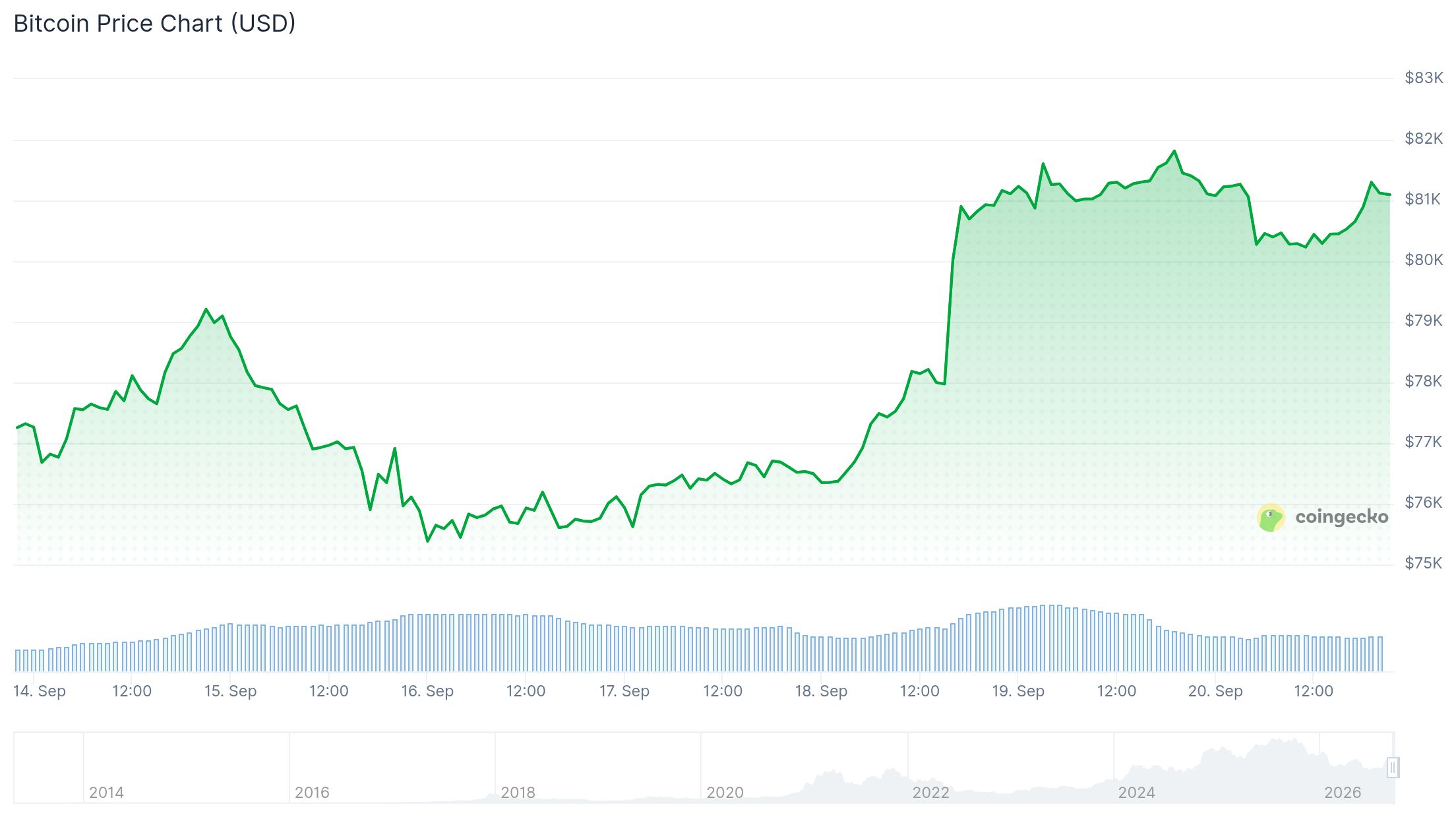
Bitcoin delivered a sharp V-shaped move from Sept. 14–20, falling to around $75,590 on Tuesday before rallying above $81,000 both on Saturday and Sunday, with a brief drop below $80,000 in between. The rebound left BTC roughly 5% higher over the seven-day period, according to data from CoinGecko
The week’s biggest regulatory setback came Sept. 15, when the U.S. Senate failed to invoke cloture on the Digital Asset Market Clarity Act, H.R. 3633. The procedural vote failed 49–50, short of the 60 votes required to advance the legislation. Bitcoin fell sharply that day, closing at about $75,590, its lowest daily close of the week.
The irony, of course, is that Bitcoin itself has never needed a bill from Congress to keep producing blocks, settling transactions or operating as designed. The legislation matters for the companies and financial institutions building businesses around it—not for Bitcoin’s ability to function.
On Sept. 16, the Federal Reserve raised its target federal funds rate by 25 basis points to 3.75%–4%, its first rate increase since 2023. The decision was unanimous, and the Fed said inflation remained elevated while economic activity continued to expand at a solid pace. Policymakers’ projections pointed to another increase before the end of 2026, adding a more hawkish element to the decision. Bitcoin, however, showed only a modest response, closing Wednesday at roughly $76,147.
Bitcoin’s roughly 5% weekly gain was not matched by a comparable surge in institutional demand. U.S. spot Bitcoin ETFs finished the week with only about $6.2 million in net inflows, despite roughly $1.5 billion of two-way flows. After taking in $160 million Monday, the funds shed $450 million Tuesday and another $296 million Wednesday, before reversing course with $160 million of inflows Thursday and $433 million Friday. The two largest Friday contributors were Fidelity’s FBTC, with $310.7 million, and BlackRock’s IBIT, with $108.4 million. The pattern suggests that ETF demand recovered alongside the price rebound rather than providing a clear source of fresh buying pressure at the start of the move.
Corporate treasury activity was similarly restrained. Strategy reported no Bitcoin purchases, leaving its holdings at 845,050 BTC, while Metaplanet and Twenty One Capital also reported no new acquisitions during the week. MARA Holdings did not make a confirmed new Bitcoin purchase during the week; a 1,292 BTC transfer on Sept. 16 was later clarified as the return of Bitcoin previously lent to FalconX, rather than fresh treasury accumulation. Strive‘s purchase of 469 BTC, disclosed Sept. 14, occurred between Sept. 8–11 and therefore predates the core reporting period. Taken together, the data point to a rebound driven more by market positioning and renewed risk appetite than by a broad acceleration in institutional or corporate accumulation.
| Put your Bitcoin price predictions to the test and build a track record — check out Glimpse, the Bitcoin-native prediction market. |
U.S. House Committee Advances Strategic Bitcoin Reserve Bill
The House Financial Services Committee advanced the American Reserve Modernization Act (ARMA), H.R. 8957, on Sept. 16 by a 28-21 vote. The bill would establish a Strategic Bitcoin Reserve under the Treasury Department and formalize a policy that currently rests on an executive order. The measure was ordered to be reported with amendments and has not passed the full House, Senate or become law.
The committee version would generally keep Bitcoin held in the reserve from being sold, exchanged or otherwise disposed of for 20 years from enactment, subject to provisions in the legislation. It would also require the government to account for its digital-asset holdings and establish custody and reporting mechanisms. The bill does not authorize taxpayer-funded open-market purchases of bitcoin; instead, it calls for Treasury and Commerce to study ways of acquiring additional BTC over five years without increasing taxes, borrowing or the deficit.
The proposal builds on President Donald Trump’s March 2025 executive order, which created the Strategic Bitcoin Reserve with Bitcoin obtained through federal criminal and civil forfeitures and directed that those holdings generally not be sold. Arkham currently tracks roughly 325,000 BTC attributed to the U.S. government, although the figure is an on-chain estimate rather than a government-published reconciled balance sheet.
Why it matters: ARMA would move the Strategic Bitcoin Reserve from an executive-policy framework toward a statutory one, while imposing a long-term retention rule on a substantial pool of government-held bitcoin.
Blink Wallet Suffers Attack on Custodial Accounts
Blink Wallet, a popular Bitcoin Lightning payments platform, temporarily shut down its services on Saturday after discovering that an attacker had accessed and drained funds from “a limited number” of custodial accounts.
According to Blink, the “large majority of funds are secure,” with only “a few dozen custodial accounts affected by the incident.” While the company did not disclose the amount stolen, it stressed that every affected account had been identified and would be made whole. The incident was limited to custodial accounts, i.e. those where Blink holds the keys on behalf of users, while users of non-custodial wallet were not affected.
We’ve paused Blink services while we investigate a security incident.
An attacker accessed a limited number of custodial accounts and withdrew funds.
The large majority of funds are secure.
Non-custodial wallets are not affected.
— Blink Wallet (@blinkbtc) September 19, 2026
At the moment, the attack path remains unclear. Blink hasn’t explained how the attacker gained access, so specific claims about the vulnerability would be premature. The company said it had investigated and fixed the issue before restoring services later on Saturday, with a full post-mortem to be published at a later date
The incident comes as Blink has been winding down custodial services in some regions amid regulatory changes, with migration deadlines falling in August and September 2026. Some users were therefore still holding funds with Blink during the transition.
Why it matters: The incident highlights the different security assumptions between custodial and self-custodial Bitcoin wallets: users of Blink’s custodial service depended on the company to secure the keys, while non-custodial users were not impacted.
Hodl Hodl Reverses Course on Silent AML Screening Following Community Backlash
Hodl Hodl has disabled a controversial Bitcoin screening system it quietly deployed on its P2P exchange, following sharp criticism from users who discovered the change mid-trade.
The peer-to-peer Bitcoin trading platform, which has built its reputation as a non-KYC alternative to centralized exchanges, announced what it described as “enhanced bitcoin security scoring” on escrow deposits without prior notice on Friday. The system checked incoming Bitcoin for “serious red flags” before allowing contracts to settle, with the company defending the move as a protective measure to prevent traders from ending up with “coins they can’t move or cash out later.”
A trader on BitcoinTalk reported that three contracts ran into the new AML check, with two auto-canceled after deposits were confirmed. The trader noted the flagged coins in one case traced back through a chain of escrow deposits from Hodl Hodl itself. Another contract sat frozen for 40 minutes in an “AML review in progress” status with no explanation. The screening fired after confirmation rather than in the background, and the label was visible to both parties—a particularly uncomfortable outcome for a platform whose users specifically choose it to avoid that kind of scrutiny.
Anna, the CEO of Hodl Hodl, issued a statement to users the following day, acknowledging the rollout was mishandled.
Dear users,
We got this wrong, and you were right to call it out.
The intent was to protect traders from ending up stuck with tainted coins – but we shipped it without warning and explained it poorly after the fact. That’s on us.
It’s disabled now. If it comes back in any… https://t.co/3Qgereo6Ld
— Anna (@annahhodl) September 19, 2026
“We got this wrong, and you were right to call it out,” she wrote on X. “The intent was to protect traders from ending up stuck with tainted coins – but we shipped it without warning and explained it poorly after the fact.”
According to Anna, the feature is now disabled, and if it returns “in any form,” Hodl Hodl will make sure it’s “clearly disclosed” in advance and won’t cost users the flexibility they expect from Hodl Hodl.
Why it matters: The concept of “tainted” coins—units flagged by chain analysis heuristics as linked to illicit activity—sits awkwardly with Bitcoin’s base-layer design, which tracks UTXOs rather than serialized coins with taint flags. Fungibility is enforced by consensus rules, not by compliance policies. When a platform known for privacy-focused P2P trading introduces screening, even as a technical measure, it raises questions about whether that ethos is being quietly eroded.
BitBox Integrates Lightning Into BitBoxApp
Swiss hardware wallet maker BitBox has added Lightning to its mobile BitBoxApp, bringing Bitcoin cold storage and everyday Lightning payments into the same application. Per the announcement, the feature is launching as a public beta for all BitBox users and works with both the BitBox02 and BitBox02 Nova. Users can create a Lightning hot wallet, move bitcoin into it directly from their on-chain BitBox wallet, and send or receive Lightning payments without installing a separate wallet.
The integration uses the Breez SDK together with Spark, removing the need for users to operate a Lightning node or manage channels and liquidity themselves. The Lightning wallet is separate from the hardware-protected wallet and its spending keys remain on the smartphone, while the existing BitBox backup can be used to recreate its keys through BIP-85 derivation. BitBox also cautions that Spark introduces additional trust assumptions compared with holding bitcoin directly on-chain.
Why it matters: BitBox is lowering the technical barrier between self-custodied Bitcoin savings and everyday Lightning spending, making the two use cases accessible through a single mobile interface.
Sparrow Wallet Releases v2.5.5
Sparrow Wallet released version 2.5.5 on Sept. 17, its second release in less than a month after v2.5.4 landed on August 27. The new version includes a long list of fixes and security-related changes, including stronger checks around PSBT signatures, silent payments, transaction data and hardware-wallet interactions. Sparrow also tightened handling of BitBox02, Trezor Safe 7, Ledger and Coldcard integrations.
The release also adds a System theme option that follows the operating system’s light or dark setting and makes it the default for new installations.
Why it matters: The rapid follow-up release shows continued maintenance of one of Bitcoin’s widely used desktop wallets, with much of the work focused on transaction integrity, hardware-wallet compatibility and silent-payment handling.