
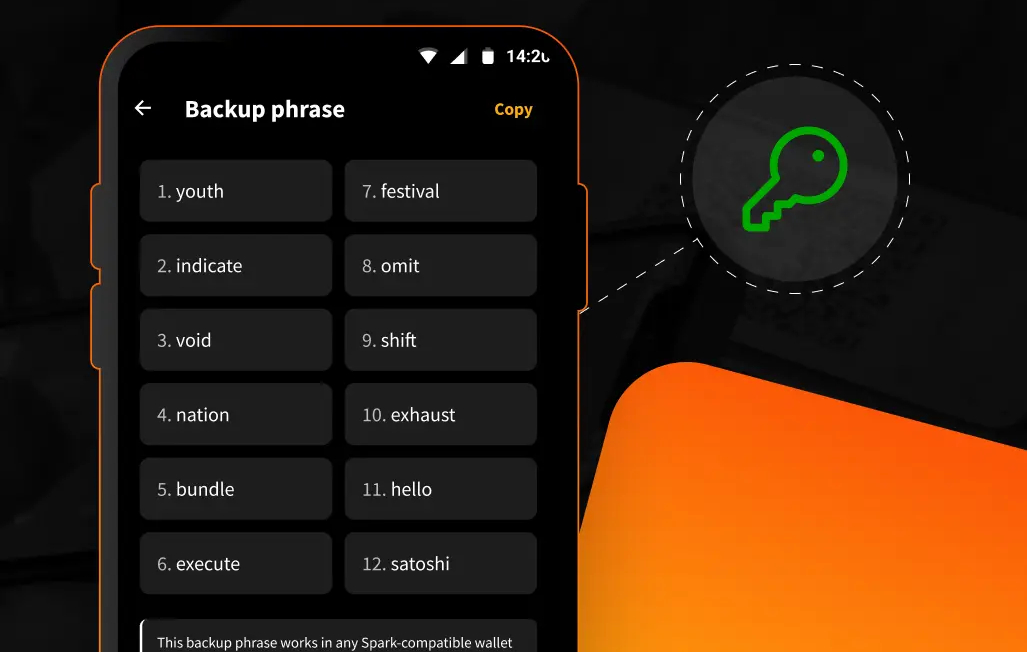
The Lightning wallet born in El Salvador’s Bitcoin Beach community has added self-custody support, powered by the Spark protocol.
Blink Wallet, one of the Bitcoin ecosystem’s most widely used Lightning payment apps, has introduced non-custodial accounts—a move that allows users to hold their own private keys rather than entrusting their funds to the company.
The update marks a notable departure from the wallet’s founding design. Blink was built in Bitcoin Beach, El Salvador in 2020 to support the development of a circular economy—a grassroots project in the surf town of El Zonte that sought to make Bitcoin usable for ordinary merchants and residents. At the time, the team concluded that a custodial setup—one where Blink holds users’ private keys on their behalf—was the only practical way to deliver a smooth experience on the still-maturing Lightning Network.
Now, with the technology landscape looking different, the company says that constraint no longer holds.
“We didn’t build this to check a box. We built it so the people onboarding the world to Bitcoin can own their funds fully, with the exact same experience they already rely on. Independence shouldn’t cost you convenience, and now it doesn’t,” said Kemal Yasar, Director of Special Projects at Blink.
How It Works
In a custodial wallet, the company controls the private keys—the cryptographic credentials that prove ownership of Bitcoin. That means users are trusting Blink to keep their funds safe, much like depositing money in a bank. Non-custodial accounts flip that arrangement: users receive a 12-word recovery phrase when setting up the account, giving them sole control over their Bitcoin. Lose the phrase, and there is no recovery option.
Under the hood, non-custodial accounts in Blink run on Spark, a Bitcoin Layer 2 protocol developed by Lightspark. Spark is designed to enable instant and scalable self-custody, extending Bitcoin and the Lightning Network to make non-custodial wallets practical for everyday users without requiring them to manage channels or run nodes.
The wallet retains the same Lightning address users already have, meaning merchants and individuals paying them do not need to change anything. A non-custodial dollar balance pegged to the greenback is also included, allowing users to hold USD-equivalent value alongside their Bitcoin without relying on Blink to custody either.
Importantly, the Spark protocol includes a unilateral exit path to Bitcoin’s base layer. According to Blink, if Spark’s operators were to become unavailable or act against users’ interests, pre-signed transactions would allow users to withdraw their funds to the Bitcoin mainnet without anyone else’s cooperation. Blink notes this exit capability is not yet exposed in the app itself, but is supported at the protocol level.
Blink Wallet now has non-custodial accounts.
Live on iOS and Android today.Your keys. Your bitcoin. Same app.
Six years in the making. pic.twitter.com/Uu4pHwkesS
— Blink Wallet (@blinkbtc) July 1, 2026
The launch comes with notable caveats. Several features available in Blink’s custodial product, including Point of Sale functionality and Circles, a group savings feature, are absent from non-custodial accounts at launch, with the company saying they may arrive later.
On the question of key backup, Blink acknowledges a genuine tension. True self-custody demands that users safely store their recovery phrase, which, if lost, results in permanent loss of funds. The company has opted to offer cloud backup to Google Drive or iCloud as a shortcut for less experienced users. While this lowers the barrier, it reintroduces a degree of dependence on third-party cloud providers, which security-minded users may find unsatisfying. Blink frames this pragmatically: a cloud backup that actually gets done is better than a more secure method that never happens.
Ahead of Regulators
Blink’s team attributes the timing partly to regulatory pressure. Increasing scrutiny of custodial cryptocurrency services across multiple jurisdictions has pushed the company to find a way to keep serving users in countries where custodial arrangements are becoming legally fraught. In some regions, Blink says it plans to migrate existing custodial users to non-custodial accounts in the near future, though it wants to ensure the new experience is stable before making that a requirement.
The wallet’s existing custodial accounts continue to work unchanged for most users. A migration path allowing users to move funds into a non-custodial account is described as coming shortly after launch.
Users can access the non-custodial option when setting up a new Blink Wallet, or by navigating to Settings → Switch Account → Add New Account within an existing installation. Regional availability varies depending on local regulations.
The full announcement is available on Blink’s blog.