
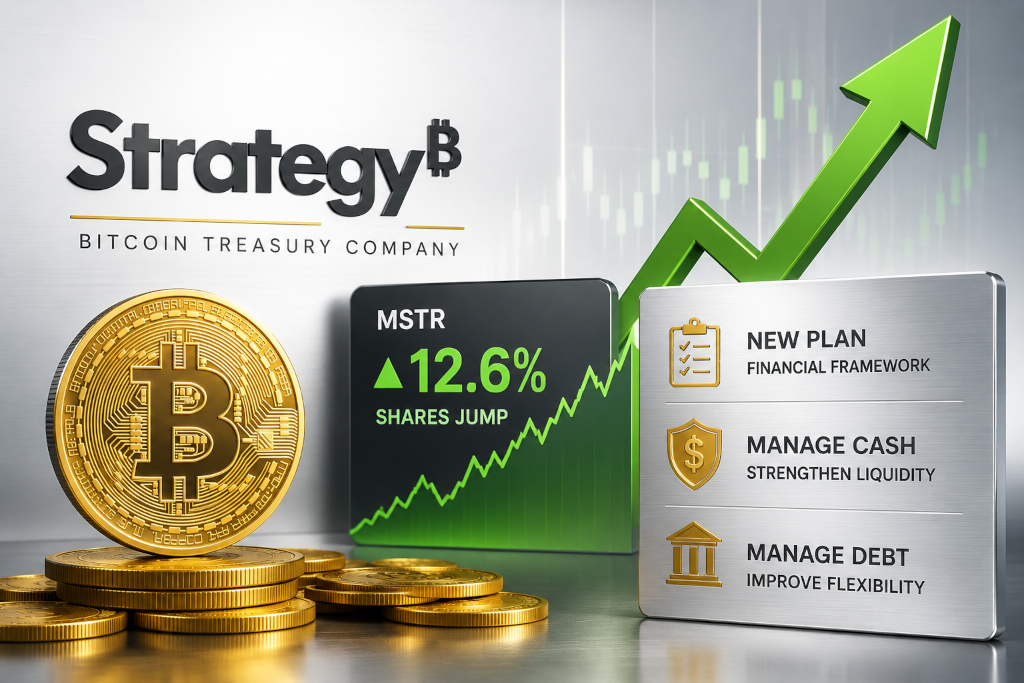
Strategy’s preferred stock recovered losses on Monday after falling to record lows last week as the Bitcoin-buying firm unveiled a new framework for managing its capital.
Shares of Strategy (MSTR), the business intelligence firm turned massive Bitcoin holder, broke a nine-day losing streak on Monday after the company rolled out a new financial framework aimed at easing investor worries about how it pays its bills.
The stock jumped 12.6% to $92.68, clawing back some of its losses for the month. The rally came after Strategy signaled that any future sales of its Bitcoin holdings would follow a clear, rules-based system rather than happening unpredictably.
Normally, Strategy starts the week by announcing fresh Bitcoin purchases. This time was different. Instead, the company told investors that its cash cushion—what it calls its “USD Reserve”—had grown to $2.55 billion, and unveiled something it’s calling a “BTC Monetization Program.”
A New Playbook for Managing Money
Strategy, led by co-founder and Executive Chairman Michael Saylor, has built its identity around buying and holding Bitcoin using money raised through stock sales and various debt and preferred stock products. But that strategy comes with ongoing costs: the company owes regular dividend payments to holders of its preferred stock products, and investors have grown increasingly concerned about whether Strategy has enough cash on hand to keep those payments flowing.
On Monday, the company tried to address those concerns head-on by introducing what it’s calling a “Digital Credit Capital Framework.” In simple terms, this is a rulebook spelling out exactly when and how Strategy might sell some of its Bitcoin to raise cash.
Under the new plan, Strategy’s board has given the company permission to sell up to $1.25 billion worth of Bitcoin if needed. That money could be used to refill its cash reserves, make dividend payments on its preferred stock products, including the one called Stretch (STRC), or buy back its own stock or other securities when it makes financial sense to do so.
“Strategy remains committed to Bitcoin as its primary treasury reserve asset,” Saylor said in a statement. “At the same time, Digital Credit requires liquidity, discipline, and active capital management.”
In other words, Saylor is saying the company still believes in holding Bitcoin for the long haul, but it also needs to be smart and careful about managing the cash needed to keep its financial obligations current.
Saylor added that the new framework is designed to “strengthen credit quality” and allow Strategy to “reduce expected preferred stock dividend payments when accretive,” meaning the company wants to lower its dividend costs when doing so actually benefits the business financially.
Strategy announces a Digital Credit Capital Framework designed to strengthen Digital Credit, enhance liquidity, preserve long-term Bitcoin exposure, and support long-term value creation. $MSTR $STRC https://t.co/AUoUCtem53
— Michael Saylor (@saylor) June 29, 2026
Bitcoin’s Price Holds Steady, Strategy’s Stock Jumps
Shortly after the announcement, Bitcoin itself was trading around $59,800, down a modest 0.5% over the previous 24 hours. Strategy’s stock, meanwhile, had already climbed 5% in pre-market trading to $86.52.
Notably, Strategy did not announce any new Bitcoin purchases Monday—a break from its usual pattern. Instead, the spotlight was on its cash reserves, which have been rebuilt to $2.55 billion. That’s a meaningful recovery; the company had originally set aside $2.25 billion at the start of the year specifically to handle dividend payments and debt costs.
Why Cash Reserves Matter
Strategy said its current cash reserves are enough to cover roughly 18 months of dividend payments. If the company does end up selling the full $1.25 billion in Bitcoin allowed under the new program, it said it would have enough money on hand to cover about 26 months—or just over two years—of dividend costs.
This matters because, in recent weeks, analysts had grown worried that Strategy’s cash cushion had shrunk to a point where it could only cover about 14 months of these ongoing costs—a slimmer safety net than investors are comfortable with for a company whose business model depends heavily on confidence in its financial stability. Going forward, Strategy says it intends to always keep at least 12 months’ worth of dividend payments in reserve.
A Sweetened Deal for Stretch Investors
Strategy also announced it’s raising the dividend rate on its STRC preferred stock product by half a percentage point, bringing it to 12%. This marks the 8th time the company has increased this particular dividend rate.
For context, STRC was designed to be a relatively stable, low-volatility investment that should trade near its $100 “par value” (essentially its intended baseline price). However, the product has recently drifted more than 25% below that level, a sign that investors had been losing some confidence in it.
“The actions announced today are intended to support that objective by strengthening preferred dividend liquidity, improving market confidence in Strategy’s Digital Credit Securities, and providing the Company with additional capital allocation tools,” the company said.
Following the news, STRC shares jumped as high as $83.67 at the closing bell Monday—a sharp recovery from Friday, when the stock had fallen as low as $71.25.
No New Stock Sales for Bitcoin Buying — For Now
Strategy also clarified that it won’t be issuing new shares of common stock to fund additional Bitcoin purchases unless its stock starts trading at a premium to the value of its Bitcoin holdings. This is tracked through a metric the company calls “mNAV” (market value relative to net asset value). As of Monday, that figure stood at 0.99, meaning Strategy’s stock is trading at a slight discount to the value of the Bitcoin it holds, rather than a premium.
Strategy’s total Bitcoin holdings remained unchanged at 847,363 coins. At current Bitcoin prices, that stash is worth close to $51 billion. However, because Bitcoin’s price has fallen since much of that stash was purchased, the holdings currently show approximately $13.1 billion in unrealized losses, i.e. paper losses that would only become permanent if the company sold its Bitcoin at today’s prices.