
Bitcoin Weekly Dispatch follows Bitcoin’s story in motion: tracking the markets, corporate moves, regulatory environment, mining progress, protocol upgrades, Lightning Network growth, and the new tools and products driving adoption.
Bitcoin Price Action
Bitcoin is trading just above $60,100 as Q2 draws to a close—a fitting coda for one of the more painful stretches in recent memory.
The week’s low came on Thursday, June 25 when BTC slid to $58,188 before recovering slightly to around $59,273, a roughly 3.3% intraday drop that compounded an already bruised chart. Over the weekend, Bitcoin briefly fell below $59,000 again, down close to 7% on the week.
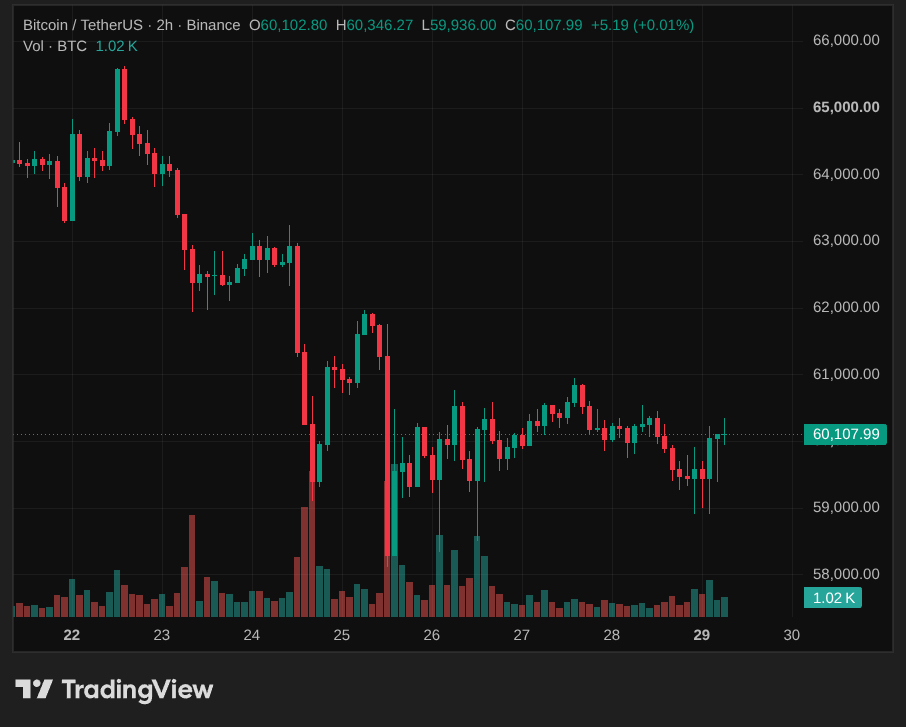
The quarter is shaping up as a roughly 12% loss for Bitcoin, and with Q1 already down around 22%, that puts 2026 on track for back-to-back red opening quarters. That’s only happened twice in Bitcoin’s history. Historically, Q2 has been one of Bitcoin’s stronger periods. This year it wasn’t.
The macro backdrop is familiar: capital is chasing semiconductor and memory-chip stocks tied to the AI boom, and Bitcoin hasn’t found a compelling counter-narrative to pull flows back. Fear & Greed sits at 13 (Extreme Fear), per Coinglass.
| Glimpse is a Bitcoin prediction market that allows participants to trade on future Bitcoin price outcomes. By combining market incentives with probabilistic forecasting, Glimpse helps users test their market views, build forecasting track records and contribute to a live forecast of where Bitcoin is headed next. |
Strategy: Cracks in the Model?
Michael Saylor’s Strategy sold 2.71 million MSTR shares between June 15 and June 21, generating $335.5 million through its ATM program. Of that, $34.9 million went toward buying 520 BTC at an average of $67,068 per coin. The company now holds 847,363 BTC, acquired at an average cost of $75,651 — meaning the entire stack is underwater at current prices by roughly $14 billion.
The more significant story is $STRC. On June 25, Strategy’s preferred shares hit a new low of $74.13—more than 25% below the $100 par value at which they were engineered to trade. $MSTR common fell 7% the same session to around $87.50. The preferred stock is designed to trade at $100, and when it does, Strategy issues more shares to fund BTC purchases. At $74, that mechanism is strained.
STRC’s current annual dividend stands at 11.5%—a figure that’s been hiked seven times, each increase adding to Strategy’s recurring obligations. Those dividends can be deferred, but the direction of travel is not reassuring. Earlier this month, Strategy sold 32 BTC for $2.5 million—its first sale since 2022—a gesture meant to demonstrate to preferred shareholders that Bitcoin holdings could be tapped if needed. Some analysts read it as a signal that further liquidations may follow.
Strategy has increased its USD Reserve by $300 million to $1.4 billion and plans to continue replenishing it to support the credit quality of its Digital Credit securities. We also acquired 520 BTC for $35 million, increasing our $BTC Reserve to ₿847,363. $MSTR $STRC.…
— Strategy (@Strategy) June 22, 2026
Meanwhile, Rosen Law Firm has launched an investigation into whether Strategy and its executives issued materially misleading statements about its Bitcoin treasury strategy and the risks of its leveraged accumulation model. The firm is inviting holders of MSTR, STRF, STRC, STRK, and STRD to participate in a prospective class action. No wrongdoing has been established, while Strategy has not publicly responded.
ETF Outflows: Record Month
U.S. spot Bitcoin ETFs recorded $1.79 billion in net outflows, the third-highest weekly total since launch. For the full month of June, outflows reached $4.06 billion—the largest monthly redemption ever, surpassing the previous record of $3.56 billion set in February 2025.
Combined with May’s $2.43 billion in net redemptions, the two-month total approaches $6.5 billion. Spot ETFs remain the primary barometer for institutional Bitcoin sentiment, and right now that barometer is pointing down.
The outflows run counter to expectations from early June, when SpaceX’s IPO on June 12 was expected to catalyze fresh interest in risk assets.
MiCA: The July 1 Deadline Arrives
While the industry’s attention has been fixed on Binance‘s regulatory situation in the EU, with the exchange withdrawing its MiCA application in Greece and pursuing authorisation in another EU Member Stat, the July 1 MiCA enforcement deadline is the bigger structural story.
Of the more than 3,000 crypto firms operating in Europe, only around 200 have secured a MiCA licence. Binance, Bitget, and KuCoin remain in licensing limbo across parts of the EU. European users of unlicensed platforms may find their access restricted as enforcement tightens, and those who migrate to compliant exchanges can expect a noticeably more bank-like experience: stricter KYC, transaction monitoring, and account restrictions.
One firm that’s ready: Bull Bitcoin has obtained a MiCA licence through France’s AMF—one of the EU’s stricter regulators—and its licence is publicly listed on the AMF’s CASP register. Under MiCA’s passporting provisions, the single French licence covers all 27 EU member states and the broader European Economic Area.

| Bull Bitcoin is on the mission to Destroy Fiat. Engineering Sovereignty and allowing you to Own Your Money, Bull Bitcoin makes Bitcoin the money of the future—starting today. |
Stratum V2 Gets a Real Block
GoMining announced it mined a Bitcoin block with the DMND pool using Stratum V2’s Job Declaration protocol, meaning the miner, not the pool, built the block template. The block was constructed to prioritize GoBTC Pay transactions.
Stratum V2 has been years in development, with contributors from across the Bitcoin ecosystem. Its central change: miners in pools can now select which transactions go into their blocks, rather than deferring to the pool operator. The GoMining block is the most visible demonstration yet of what that looks like in practice.
“This block shows what becomes possible when miners control their own block templates. For years, pools decided which transactions made it into Bitcoin blocks,” said Mark Zalan, CEO of GoMining.
Whether this represents a meaningful shift in mining centralisation or remains a headline demonstration is a question the next few months will answer.
Sparrow Wallet: Crisis Averted
Craig Raw, creator of Sparrow Wallet, announced on X that Apple has reversed its decision to terminate his developer account after an appeal to the App Review Board.
The backstory: Apple flagged a placeholder app Raw had submitted—one whose sole purpose was to warn users that Sparrow is a desktop application and that any “Sparrow” app on the App Store is not his. Apple’s automated system classified this as “dishonest activity,” triggering a termination notice that, if upheld before June 30, would have blocked all new installs and ended macOS development.
After Raw posted publicly and the Bitcoin community amplified the situation, Apple reviewed the case and reversed course.
But while the immediate threat is gone, the underlying problem is not. More than a dozen fake Sparrow apps have appeared on the App Store since 2023, as recently as April this year. Users have contacted Raw after losing savings—in some cases their entire savings—to these impersonators. Raw holds registered US trademarks for the Sparrow name and logo, has flagged the fakes to Apple repeatedly since early 2024, and they keep appearing.
Upcoming Event: Mining Disrupt 2026 Miami

Mining Disrupt Conference & Expo 2026 is the premier global event for Bitcoin mining, uniting innovators and enterprise-level blockchain solution experts. Experience an extensive range of exhibitors alongside an impressive lineup of keynote speeches and discussion panels featuring renowned speakers from around the world.
Explore the latest products, strategies, and trends that are reshaping the Bitcoin mining industry.
🎟️ Tickets are now available — and you can save 20% by using the promo code BitcoinEventsHQ at checkout.
Explore more events on BitcoinOnly Events.