
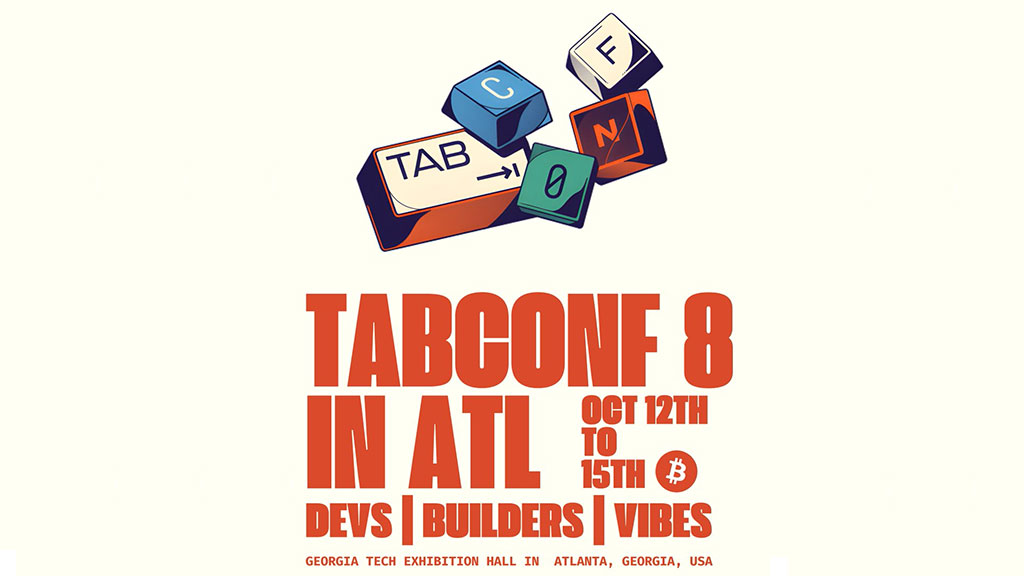
In Bitcoin, conferences often mirror the era that created them. Some emerge during hype-driven cycles, built around market narratives and celebrity speakers. Others become corporate showcases as institutional money flows into the ecosystem. Very few remain deeply technical for long. Even fewer choose to end before losing the culture that made them relevant in the first place.
The Atlanta Bitcoin Conference (TABConf) is doing exactly that.
After nearly a decade of shaping one of Bitcoin’s most respected grassroots technical communities, TABConf will hold its final edition October 12–15, 2026, in Atlanta, Georgia. The announcement came from co-founder Michael Tidwell, who presented the decision not as a shutdown, but as the natural conclusion of a mission that had already succeeded.
“TABConf was never built as a business. It has always been community service: volunteer run, historically carried by a small core group of a few people, with a much larger group of volunteers making it possible every year,” Tidwell wrote on X. “The goal was always simple: keep it technical. Avoid price action, charts, “wen moon” talks, and hype.”
And in many ways, that may be the most Bitcoin-native decision the conference could make.
TABConf began in 2016 as a meetup during a very different period for Bitcoin. Dedicated builder communities were smaller, technical gatherings were scarce, and many conversations across the ecosystem still revolved around convincing outsiders that Bitcoin mattered at all.
By 2018, the Atlanta Bitcoin meetup had grown large enough to evolve into a full conference. But unlike many events chasing mainstream attention, TABConf deliberately positioned itself away from hype cycles and speculative culture, keeping its focus clear from the beginning: builders, operators, educators, and technically curious users.
The conference became known for prioritizing practical knowledge over headlines, with discussions centered on wallets, privacy, infrastructure, open-source development, custody, Lightning, scripts, and operational security rather than market predictions or price narratives.
“I have always said TABConf is not the place to come learn why Bitcoin is great,” wrote Tidwell, adding that “it is the place where, once you know Bitcoin is great, you come to learn what you can do next.”
According to him, TABConf “has always been a builders and doers conference.”
That mindset helped TABConf develop a reputation that stood apart from larger industry events. At a time when many conferences optimized for scale, sponsorship visibility, and mainstream accessibility, TABConf leaned further into technical depth. The organizers embraced unconventional formats, interactive workshops, and community-driven experiments that encouraged participation instead of passive consumption.
One of the event’s most recognizable traditions, Capture the Bitcoin, transformed attendees into active problem-solvers, sending them through scavenger hunts and technical challenges to claim a bitcoin prize.
Under the guidance of Tidwell and co-founder Brandon Black, TABConf adopted a radically transparent approach to conference planning, managing much of its organization publicly through GitHub. The same model applies to this year’s edition, treating conference coordination more like an open-source software project than a traditional business operation—an approach that later influenced other Bitcoin events and developer communities.
Importantly, TABConf was never designed to become a large commercial enterprise. Tidwell emphasized in his announcement that the conference remained volunteer-run throughout its existence, supported by a relatively small core team and a much larger network of contributors who believed in preserving a highly technical space within Bitcoin culture.
Ending because it worked
When Scaling Bitcoin faded from prominence, there were relatively few places where developers and advanced users could gather for focused technical discussions without the distractions of broader industry marketing. TABConf helped fill that void during a critical stage in Bitcoin’s maturation.
Today, however, the ecosystem looks fundamentally different.
Regional editions of Bitcoin++, communities like BitDevs and Presidio Bitcoin, gatherings such as Adopting Bitcoin, OP_NEXT, and the MIT Bitcoin Expo now provide technical forums across multiple continents and specialties.
According to Tidwell, that evolution represents success rather than competition: the gap TABConf was created to fill has largely been filled, and “that is a good thing!”
That perspective stands out in an industry where organizations often continue operating long after their original purpose has faded. Instead of stretching the brand indefinitely, TABConf’s organizers appear determined to preserve the conference’s identity while it still carries genuine meaning within the builder community.
The announcement also highlighted something often overlooked in discussions about Bitcoin infrastructure: the human layer.
Over the years, TABConf attendees formed friendships, launched projects, discovered career opportunities, and even met future spouses. Those outcomes are difficult to quantify, but they help explain why certain gatherings become culturally important beyond their official agendas. Communities built around open-source software are sustained as much by trust and shared values as by code itself. TABConf succeeded because it cultivated both.
On personal responsibility
Tidwell also used the announcement to defend a principle increasingly debated within Bitcoin: the relationship between usability and personal responsibility.
He argues that meaningful sovereignty still requires a baseline level of technical competence—a view that runs counter to the growing belief that every layer of complexity should be abstracted away from users entirely. In his view, learning how digital money works remains an essential part of using it responsibly, and “the healthy place is somewhere in the middle.
“Taking responsibility for your own digital money is still a new idea for many people,” stated Tidwell.
That philosophy shaped TABConf from the start. The conference treated technical literacy not as an elite skillset reserved for engineers, but as something ordinary users could gradually develop through experimentation, repetition, and hands-on participation.
“No one is too old, too new, or too “non technical” to learn how Bitcoin works. But that knowledge requires practice, repetition, and maintenance,” said Tidwell.
As TABConf prepares for its final edition in Atlanta this October, the mood surrounding the event feels less like mourning and more like recognition. Recognition that a conference born from a small meetup succeeded in helping cultivate a generation of Bitcoin builders. Recognition that the technical culture it helped protect no longer depends on a single event to survive.
And recognition that ending on purpose—before the mission becomes diluted—may ultimately be one of the strongest signals a community can send about what it values.