

The past several weeks have delivered more turbulence to the Bitcoin mining industry than most quarters combined. A historic difficulty crash, a record-breaking rebound, a wave of operator bankruptcies, a prolonged capitulation cycle, and a quiet but accelerating exodus toward artificial intelligence infrastructure—the sector is undergoing a structural shift that will define what mining looks like for years to come.
Here is what happened, and what it means.
The Biggest Difficulty Swing in Five Years
It started on February 7. A severe winter storm swept across the United States, knocking an estimated 40% of the network’s hashrate offline in a matter of days. The resulting downward difficulty adjustment came in at roughly 11.2%—the largest single drop since China banned Bitcoin mining in May 2021, and larger even than the adjustment that followed the FTX collapse and the bear market lows of December 2022.
Hashprice, the revenue miners earn per unit of computing power, collapsed below $30 per petahash per second, pushing a significant portion of the network toward or below break-even. For older-generation machines already running on thin margins, the calculus became impossible.
Then the network corrected itself. On February 19, difficulty snapped back with a 14.73% upward adjustment—the largest absolute increase in Bitcoin’s history, and the biggest percentage move since the post-China recovery in 2021. The scale of the rebound confirmed that the February drop was largely weather-driven, not a signal of structural network decline. Hashrate returned quickly once the storm passed.
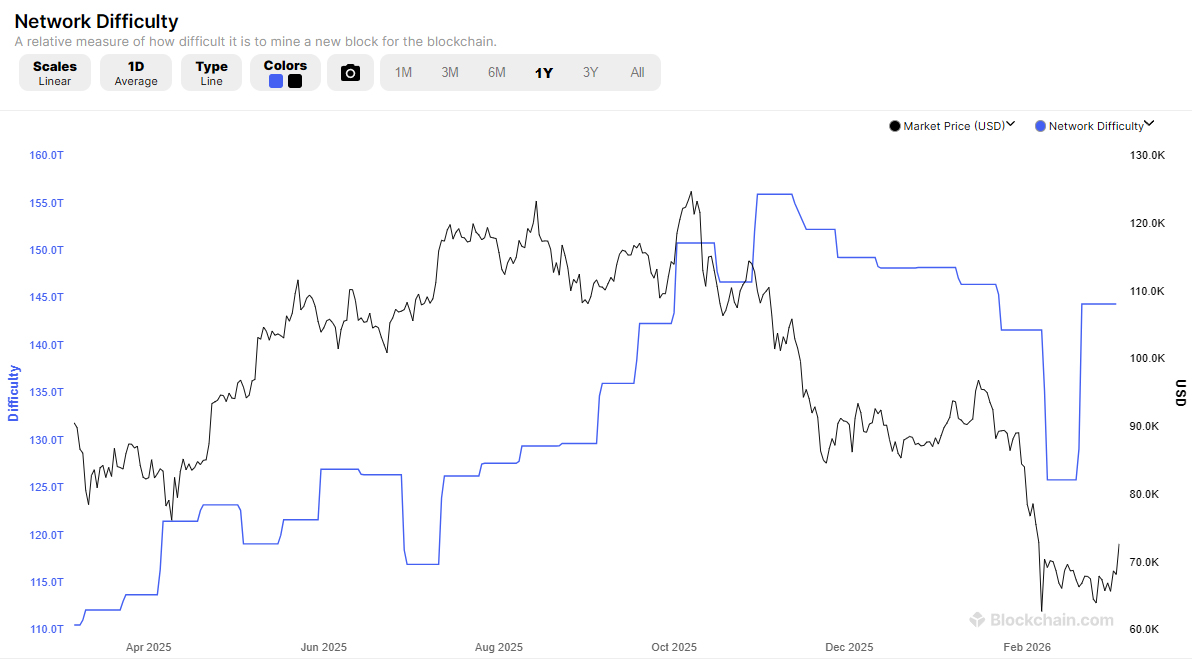
Source: Blockchain.com
Capitulation: Longer Than Almost Any on Record
Behind the headline numbers, a quieter and more consequential process had been unfolding for months. The Hash Ribbon, a widely followed on-chain metric that tracks the relationship between short-term and long-term mining participation, was signaling one of the longest sustained miner capitulation periods on record, stretching back to late 2025.
By late February, Bitcoin was trading below the estimated average all-in production cost for the first time since November 2022. That is a level that has historically coincided with late-stage capitulation—periods where inefficient operators exit, consolidation accelerates, and the network’s remaining participants tend to be better-capitalized and longer-duration. Glassnode data indicated the Hash Ribbon was close to flipping back to a recovery signal as of February 25, though the broader environment remained fragile.
Companies That Didn’t Make It
Some operators did not survive the squeeze. NFN8 Group filed for Chapter 11 bankruptcy protection on February 2, becoming one of the more prominent casualties of a period that saw several smaller mining operations shutter altogether. The combination of compressed hashprice, rising energy costs in certain markets, and Bitcoin’s decline from its late-2025 highs created conditions where undercapitalized operators had little room to maneuver.
The most significant collapse, however, came from outside the United States. BitRiver, which once controlled over 50% of Russia’s industrial mining market, entered bankruptcy proceedings on January 27 after a court opened insolvency supervision against Fox Group, the entity that owns 98% of BitRiver’s authorized capital. The trigger was a $9.2 million equipment dispute with Infrastructure of Siberia, an En+ Group subsidiary that had paid in advance for hardware that was never delivered.
At its peak, BitRiver operated 15 data centers across Russia, ran more than 175,000 mining rigs at 533 megawatts of capacity, and generated $129 million in revenue in 2024. Its founder and CEO Igor Runets was placed under house arrest on February 2 on multiple tax evasion charges—completing a collapse that had been years in the making. The company was sanctioned by the US Treasury Department in April 2022, making it the first cryptocurrency mining company ever placed on the Specially Designated Nationals list, following Russia’s invasion of Ukraine.
The sanctions severed access to Western equipment suppliers and international clients; Japan’s SBI Group, one of its largest partners, exited the relationship entirely in 2023. What followed was a slow unraveling — unpaid wages from late 2024, equipment fraud lawsuits in 2025, mining bans imposed across its Irkutsk, Buryatia, and Ingushetia facilities — before the courts stepped in.
Russia’s broader mining sector is paradoxically still expanding, with grid-connected mining capacity up 33% in 2025 to 4 GW, but BitRiver will not be part of whatever comes next.
These exits are painful for the companies involved, but they follow a pattern that repeats in every mining cycle: stress concentrates losses among the most leveraged and least efficient, and the network absorbs the departed hashrate over subsequent adjustment periods.
The Pivot to AI: From Strategy to Standard
What is genuinely new in this cycle—and what distinguishes it from prior shakeouts—is how many publicly traded miners are actively repositioning themselves as AI and high-performance computing infrastructure providers, not just as Bitcoin producers.
Bitdeer made the most dramatic move. The company liquidated its entire Bitcoin treasury in February, selling all newly mined coins along with more than 1,100 BTC it had been holding, deploying the proceeds into a $325 million expansion into AI infrastructure. The plan includes data center conversions and cloud services built around NVIDIA’s GB200 NVL72 systems. The message was unambiguous: for Bitdeer, the future is not in holding Bitcoin.
Bitdeer #BTC Weekly Update
🔹 BTC Holdings: 0 (pure holdings, excluding customer deposits)
🔹 BTC Output: 189.8 BTC
🔹 BTC Sold: 189.8 BTC
🔹 Net BTC Added: -943.1 BTC
📅 Data as of February 20, 2026.#Bitcoin #BTC #BitcoinHoldings #BitcoinCommunity #BTCMining $BTDR pic.twitter.com/vtvBVEui0Q— Bitdeer (@BitdeerOfficial) February 21, 2026
Riot Platforms reported its full-year 2025 financials at the start of March, noting that it had effectively repurposed its nearly two-gigawatt power portfolio for high-demand data center infrastructure, with its AMD partnership already generating revenue as of January 2026. Mining revenue reached $576 million for the year, but the strategic framing made clear that Riot sees its power assets—not its ASIC fleet—as its primary long-term advantage. CleanSpark, for its part, stated openly that Bitcoin mining investment “doesn’t make a lot of sense” at current hashprice levels compared to available AI returns.
Sector-wide, capital expenditure on data center infrastructure among mining companies increased approximately 400% between March 2025 and February 2026—a figure that, more than any single company announcement, captures the speed of the transformation underway.
The Contrarians
Not everyone is pivoting. American Bitcoin, the mining venture backed by the Trump family, announced on March 3 that it had purchased 11,298 new ASIC miners, expanding its fleet by roughly 12% and adding approximately 3.05 exahashes per second. The machines are slated for deployment at its Drumheller, Alberta facility this month. The move is a deliberate bet that Bitcoin mining economics will improve—and that owning a larger share of hashrate at a point of network stress is precisely the right time to deploy capital.
It is worth noting that institutional investors appear to be taking a differentiated view. Clearline Capital LP disclosed in a February 17 SEC filing that it had added more than 3.4 million shares of Core Scientific, a transaction valued at roughly $59.9 million. Core Scientific shares were up approximately 39% year-over-year at the time of filing—significantly outpacing the broader market—as the company executes its own transition toward AI data center services.
A Governance Fight Brewing in the Background
While the industry was absorbing the difficulty crash and the wave of company pivots, a separate and arguably more consequential dispute was escalating in Bitcoin’s development community—one with direct implications for miners.
On March 2, Ocean mining pool mined the first block signaling support for BIP-110, a proposed temporary soft fork that would restrict the amount of arbitrary, non-monetary data permitted in Bitcoin transactions. The moment was symbolic but consequential: Ocean’s pool, run by long-time Bitcoin Core developer and Bitcoin Knots maintainer Luke Dashjr as CTO, is the most visible institutional backer of the proposal, and mining a signaling block was the first concrete on-chain step toward potential activation.
The proposal itself is narrow in stated scope: it would cap OP_RETURN outputs at 83 bytes, restrict individual data pushes to 256 bytes, and limit several other scripting mechanisms used to embed large files on-chain—for a period of one year. Supporters, primarily within the Bitcoin Knots community, argue that allowing unlimited arbitrary data storage bloats the blockchain, raises hardware requirements for running full nodes, and diverts block space from its intended monetary purpose. Bitcoin Knots’ share of the node network has grown to roughly 22.5%, while Bitcoin Core’s share has fallen to about 77.4%, a significant shift that reflects how seriously a portion of the community is taking the dispute.
The opposition, however, is substantial and technically pointed. The controversy deepened on March 1 when Slovak developer Martin Habovštiak inscribed a 66-kilobyte image directly onto the Bitcoin blockchain as a single transaction—without using any of the mechanisms BIP-110 targets: no OP_RETURN, no Taproot, no OP_IF instructions. The image depicted Dashjr himself. Habovštiak then produced a BIP-110-compliant version of the same transaction and found it was paradoxically larger than the original, arguing that the proposal would increase total stored data rather than reduce it.
Blockstream CEO Adam Back warned that BIP-110 poses more risk to Bitcoin’s credibility as a reliable store of value than the data it purports to address, and raised the prospect of a chain split. Questions about the proposal’s authorship have added further friction: developer Greg Maxwell alleged publicly that Ocean was the true originator of the proposal, submitted under a pseudonym to obscure the pool’s involvement—a claim Dashjr denied.
it’s worse as it is an attack on bitcoin’s credibility as a store of value, it’s security credibility, and a lynch mob attempt to push changes there is not consensus for. spam is just an annoyance, it all definitionally fits within the block-size. the op returns are 4x smaller.
— Adam Back (@adam3us) February 15, 2026
The governance dimension is where miners should pay closest attention. BIP-110 proposes activation at a 55% miner signaling threshold, a dramatic departure from historical norms—BIP9, the standard activation mechanism used for SegWit in 2017, required 95% miner consensus, and Taproot’s 2021 “Speedy Trial” activation used 90%. Critics argue that a 55% threshold could, in theory, force a change on the remaining 45% of the network, introducing chain split risk. Proponents counter that the one-year sunset clause limits the downside.
For miners, the practical stakes are clear. Inscription and Ordinals activity—the data-heavy transactions BIP-110 targets—has been a meaningful fee revenue source, even if it has declined significantly from its 2023 peak. Daily inscription fees have fallen below $10,000 at current levels, compared to nearly $10 million in a single day in December 2023. But miners operating in a post-halving environment with compressed hashprice are reluctant to rule out any revenue stream, and most mining pools have not signaled support for the proposal. Ocean remains largely isolated in its position among major pools.
The deeper question BIP-110 forces into the open whether Bitcoin’s block space is a neutral resource or one that should be governed toward specific uses—is one the industry has avoided settling for years. With Ocean pool putting its hash power behind a governance position, and with other major miners dependent on the very fee revenue the proposal would curtail, that question may not stay deferred much longer.
Where Things Stand
The mining industry entering spring 2026 looks markedly different from the one that emerged from the April 2024 halving. The margin environment has forced a genuine reckoning: operators who cannot access cheap, reliable power or who lack the capital and relationships to participate in AI infrastructure buildout are facing an increasingly difficult path. Those who can are finding that their existing assets—land, power contracts, cooling infrastructure, operational expertise—are worth more in a data center context than they ever were as pure-play mining facilities.
The questions this raises—about what Bitcoin mining companies actually are, about who the next wave of operators will be, and about how the network’s security model evolves as mining economics shift—are the kinds of questions that require more than a press release to answer.
They are also exactly the kinds of questions that will be on the agenda at Mining Disrupt 2026 in Miami, July 21–23. Mining Disrupt is one of the longest-running dedicated mining industry conferences, bringing together operators, investors, hardware manufacturers, and energy providers to cover the technical, financial, and strategic dimensions of the space. If the past month is any indication, the conversations there will be substantive. Tickets are available through Eventbrite, and readers can use the code BitcoinEventsHQ at checkout for 20% off registration. More information on speakers and programming is at miningdisrupt.com.

The industry has weathered difficult stretches before. What is different now is that the path forward is no longer singular — and the decisions being made today about infrastructure, capital allocation, and business model will determine which companies are still relevant when the next cycle turns.