

Smashtoshi, a collaborative project uniting prominent Bitcoin and digital artists, launched its “History of Bitcoin” initiative at Asprey Studio in London.
The event marks the debut of a limited-edition physical art book that chronicles Bitcoin’s journey through original artworks, kicking off a series of global events in cities including Amsterdam, New York, Dubai, and Abu Dhabi. The project aims to preserve and make accessible Bitcoin’s decentralized history, from its cypherpunk roots to its role in financial sovereignty.
The launch coincides with an online auction of the book’s First Edition, set to begin on December 1 and conclude at Bitcoin Abu Dhabi on December 9. Proceeds from the auction will largely support Bitcoin education efforts, with 80% donated to the non-profit My First Bitcoin, which has already educated thousands of students in El Salvador and plans to expand globally.
A Visual Chronicle of Bitcoin’s Milestones
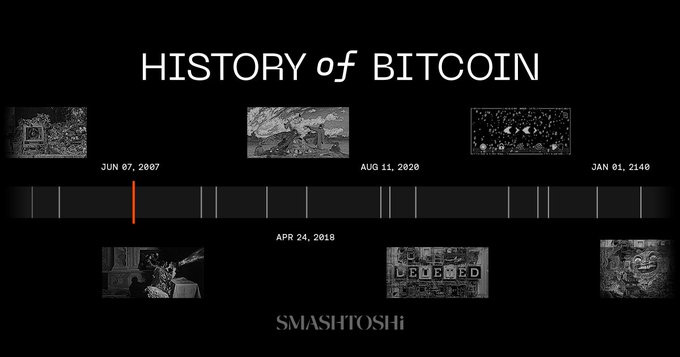
The “History of Bitcoin” book serves as a 256-page visual narrative, referencing Bitcoin’s SHA-256 cryptographic algorithm in its page count. It features never-before-seen artworks by 128 internationally acclaimed artists, each inspired by key moments in Bitcoin’s history, such as the publication of Satoshi Nakamoto’s whitepaper and the famous Bitcoin Pizza Day transaction in 2010. These pieces are complemented by research drawn from over 100 interviews, including those with early Bitcoin contributor Martti Malmi, financial commentator Max Keiser, and journalist Aaron van Wirdum.
The book’s creation involved more than 300 contributors over the past three years, encompassing artists, writers, and craftsmen. It employs over 40 specialized print techniques and materials to reflect Bitcoin’s technical complexity. The First Edition is housed in a collector’s box made from 5,000-year-old fossilized black oak, featuring a dual-sided closing mechanism and a bespoke emblem crafted by Asprey Studio. This edition is designed not only as an artistic artifact but as a durable vessel for preserving Bitcoin’s legacy for future generations.
Following the auction, 2,139 Collector’s Editions will be released, bringing the total to 2,140 copies—a number symbolizing the year 2140, when the last Bitcoin is projected to be mined. Each Collector’s Edition is bound in Bitcoin Orange Bull Leather and displayed on a stainless steel stand engraved with the complete Bitcoin whitepaper. Notably, every book contains a unique portion of Bitcoin’s original source code, ensuring that the full codebase is distributed across all editions, mirroring the network’s decentralized structure.

Collaborative Effort and Community Focus
The project emphasizes community collaboration, echoing Bitcoin’s open-source origins.
“Over the past three years, more than 300 people have contributed to bringing History of Bitcoin to life,” Jimmy Block, a representative of Smashtoshi, stated. “It’s not just an art book – it’s the shared effort of a global network of artists, writers, and craftsmen who believe in preserving this technological marvel through art. That sense of community is what makes the project truly unique.”
Smashtoshi’s initiative extends beyond the book to an interactive digital experience, including a free Bitcoin online timeline with researched articles accompanying each artwork. This digital component ensures broader accessibility, allowing millions to engage with Bitcoin’s history without purchasing the physical edition.
The global tour will feature immersive experiences at each stop, blending art, technology, and community discussions. These events are intended to highlight Bitcoin’s cultural impact and technological advancements, drawing attendees from the crypto community and beyond.
Implications for Bitcoin’s Cultural and Educational Landscape
By transforming Bitcoin’s technical history into an artistic format, “The History of Bitcoin” addresses a gap in public understanding of the world’s leading cryptocurrency. The project’s focus on firsthand accounts from pioneers like Malmi, who collaborated with Satoshi Nakamoto in Bitcoin’s early days, and Keiser, a vocal advocate for Bitcoin as a financial tool, provides contextual depth. Van Wirdum, known for his reporting on Bitcoin’s development, contributes insights into its evolution from code to a global phenomenon.
The donation to My First Bitcoin underscores the project’s philanthropic angle. The organization, which promotes independent and community-led education, has ambitions to reach over 200 million learners worldwide. This aligns with broader trends in the Bitcoin space, where educational initiatives seek to demystify blockchain technology and foster adoption in underserved regions.
The upcoming auction on Scarce City, concluding in Abu Dhabi, will determine the distribution of the First Edition and generate funds for educational programs. Depending on bidder interest, the proceeds could accelerate My First Bitcoin’s expansion, potentially establishing new chapters in additional countries.
In an era where digital assets continue to reshape finance, “History of Bitcoin” stands as a tangible reminder of the innovation’s origins and potential. The tour’s progression through key hubs will likely draw attention to Bitcoin’s enduring legacy, fostering discussions on its future role in global economics. The initiative may also inspire similar efforts to document other aspects of cryptocurrency history, contributing to a richer archival record of the industry’s growth.
For more info visit https://www.historyofbitcoin.io/